Buy This, Not That: $43 Billion in Debt vs. a 24% Profit Machine
Shah Gilani|August 6, 2025

Two entertainment titans. Same industry. Wildly different balance sheets.
One company is drowning under $43 billion in crushing debt… while its rival is generating fat 24% profit margins and swimming in cash.
The numbers are brutal. One delivers a measly 8.89% return on equity… the other crushes it with 43.55%.
One pays a dividend so tiny it’s “not even worth mentioning”… the other is building a cash machine that’s rewriting the rules of media.
The stock charts tell an even more dramatic story. Over the past two years, one has gone absolutely nowhere – “a lot of nothing,” as I call it.
The other? A beautiful breakout that keeps marching higher.
Click on the thumbnail below to see which entertainment giant wins.
Transcript
Hey, everybody. Shah Gilani here with your weekly BTNT as in “Buy This, Not That.” Today, I’m putting Netflix (NFLX) up against Disney (DIS). Why?
Because Netflix is trying to be, according to some analysts and some bankers and some investors, the next Disney. But Netflix is Netflix. And let me say this about that. As far as Disney goes, Netflix has a long way to become the next Disney.
Yeah, I’ll get into some of the things they’re doing that are moving them in the Disney direction. But first, let’s talk about Disney.
Walt Disney Company has been around a long time. This is a $214 billion market cap company with annual revenues trailing 12 months close to $95 billion, profit margin 9.48%. A very well-run company historically. But they have some management issues. They have a succession issue. They have other issues that are too lengthy to get into, mostly management. And also, there are some direction issues, but there’s also balance sheet issues in terms of the debt. So a little bit more on Disney.
Quarterly revenue growth year over year, a decent 7%.
Cash on the balance sheet, $5.85 billion, but debt a whopping $43 billion in debt. That’s a lot of debt service. With a profit margin of 9.48% on that revenue, they’re achieving probably a reasonable coverage ratio, given the size of the debt. Operating margins are pretty good.
Levered free cash flow is good. So can’t really fault the balance sheet other than the heavy debt load. They’re going to have to work that debt. It is a bit of an albatross around Disney’s neck, and it has been for some time.
Nonetheless, Disney’s return on equity in the trailing 12 months, 8.89%. Not too bad. Not great, but not bad for a very sizable, old and shall I say established company. Now, the thing that Disney does great is it gets tremendous brand recognition.
It’s got tremendous diversification in terms of movies, original content. The licensing is brilliant. The merchandising is brilliant. The theme parks, their extension of profiting from everything that they bring into the house of the mouse is really well done for the most part and has been for years.
Let’s take a look at the stock to see the problem with Disney.
Here’s a one-year chart…
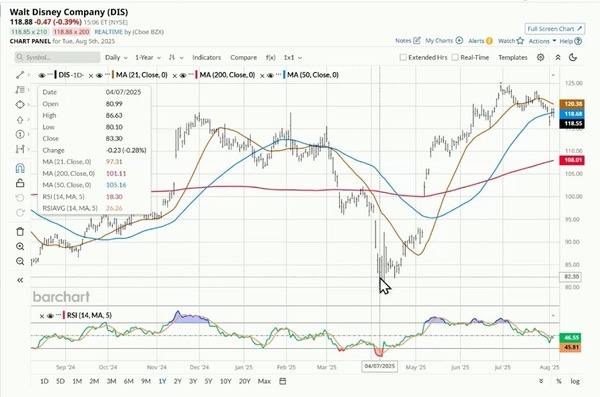
Now, yes, here we’re going down here to obviously the April meltdown here, the tariff tantrum. But the stock’s kind of sloppy on a one-year basis had a nice recovery. But really, want to have some perspective looking at Disney. Take a look at a two-year chart.
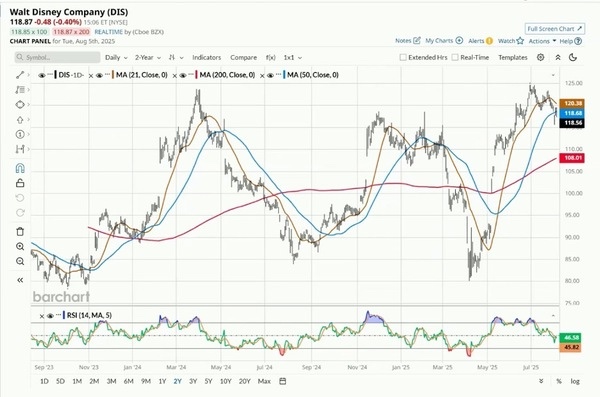
That’s a lot of nothing to me. That’s a lot of volatility holding a company that pays a tiny, tiny dividend. It’s not even worth mentioning. It’s less than 1%. But given that amount of debt, they’re not going to likely raise that dividend any time soon.
So they could, but don’t count on it. Nobody’s going to buy Disney for its dividend. Now, Netflix, on the other hand.
Take a look at Netflix two-year stock chart.
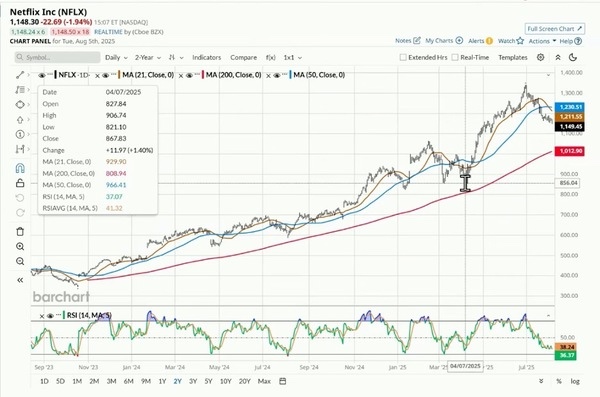
And you’ll see quite a bit of difference. So Disney, two-year, bumpy as all get out. Netflix, not as big as Disney in terms of revenues.
But that’s a two-year chart of Netflix. Yeah.
Come on, people. Here’s that April low, but it was making a beautiful move up. Really, a little bit of volatility here, then breaks out and then keeps going higher. This is a much better two-year chart.
You go longer term, Disney and Netflix don’t even compare. The return on equity for the trailing 12 months for Netflix is 43.55% return on equity versus Disney’s 8.89%. Again, Netflix is not nearly as big as Disney in terms of revenue.
Revenues here $41.7 billion trailing 12 months versus Disney’s $94 billion. But the profit margin Netflix 24.58%. So a very fat profit margin relative to Disney’s 9.48%. As far as the balance sheet, $8.39 billion in cash versus Disney’s $5.85 billion. Disney’s debt, $42.89 billion and Netflix debt, $16.93 billion.
Now, yes, Netflix is trying to encroach on some of Disney’s territory in terms of, well, yeah, here’s what we do in this big pool that Disney plays in. But Netflix is moving into creating experiences using the content that they mostly create. So it’s a better content creator, in my opinion, than Disney. Yes, Disney has strong brand recognition that goes back years, but Netflix is the new mover and has been for some time in streaming, and it is creating fantastic new content.
And they’re also able to curate that content on behalf of subscribers. So it’s the poster child for the subscriber model. So it’s got a lot more going for it than I think Disney has. And Netflix certainly looking at the chart, looking at the stock and looking at the return on equity and appreciation of the stock over the last decade dwarfs Disney.
So, yes, Netflix is a buy. Disney?
Sorry, Disney.
Catch you guys next week.
Cheers.

Shah Gilani
Shah Gilani is the Chief Investment Strategist of Manward Press. Shah is a sought-after market commentator… a former hedge fund manager… and a veteran of the Chicago Board of Options Exchange. He ran the futures and options division at the largest retail bank in Britain… and called the implosion of U.S. financial markets (AND the mega bull run that followed). Now at the helm of Manward, Shah is focused tightly on one goal: To do his part to make subscribers wealthier, happier and more free.