Buy This, Not That: Time for the Small Cap Gold Rush?
Shah Gilani|September 17, 2025

The Fed is cutting rates. That should be rocket fuel for small companies that rely on cheap borrowing to grow, right?
That’s the conventional wisdom, anyway.
But that’s not where I want to put my money right now.
While every major index – the S&P 500, Nasdaq, even the Dow – has hit new highs this year, small caps are still lagging behind.
The IWM fell 30% earlier this year and hasn’t recovered to new highs.
The problem? Small caps are packed with unprofitable companies that get crushed when markets turn volatile. Lower rates won’t fix that fundamental issue.
See which index I prefer right now in today’s Buy This, Not That.
Click on the thumbnail below to dive in.
Transcript
Hey, everybody. Shah Gilani here with your weekly BTNT, as in Buy This, Not That. I’ve gotten a lot of emails asking whether I prefer a small cap index to trade or invest in or a mid cap index to trade or invest in. So I’m going to pit the two most popular small cap and mid cap index ETFs against each other.
For this week’s BTNT, it’s a battle between the ubiquitous IWM, which is the iShares Russell 2000. Symbol again is IWM. That is by far the most popular small cap ETF.
It is based on the Russell 2000 index itself, and the symbol for the Russell 2000 index is RUT.
Everyone who likes small caps is probably familiar with IWM. Again, it’s by far the most popular. It’s also the broadest small cap index, containing a little more than 2,000 stocks, depending on which ones fall in and out. Sometimes it’s a little under, sometimes one or two over, but it’s 2,000 stocks. The beauty of it is plenty of liquidity, widely held, actively traded, and I think a good representation of the small cap universe.
The counter to that is the Russell mid cap index. The Russell mid cap index symbol is RML, and the corresponding iShares Russell mid cap ETF is IWR. So IWR is the mid cap, and IWM is the small cap.
As far as IWR goes, the mid cap Russell is probably the broadest mid cap index, and it consists of the bottom 800 of the 1,000 largest companies listed on U.S. exchanges. So it’s the bottom 800 of the largest 1,000. In other words, it’s got pretty much most of the companies in it except the mega cap, really big cap stocks. So that’s the mid cap designation there.
Comparing one to the other, the problem I have with IWM, with the small caps, is there are a lot of unprofitable companies in there. Yes, you get a nice weighting on emerging tech. Yes, you get a nice weighting in biotech. Yes, you get a lot of small, midsize banks, regional banks, and community banks in there.
You get a lot of exposure to that stuff, but there are a lot of unprofitable companies in the Russell 2000. Whereas with the mid caps, most of those companies are large enough to, for the most part, likely be profitable and certainly have been established long enough where they’re not coming out of the box trying to prove themselves. So the mid cap seems to be more stable. It is less volatile. IWR is less volatile than IWM.
Let me pull up a couple of charts because when you’re looking at them and trying to figure out which one to trade or invest in, you’re going to have a hard time because chart-wise, they look very similar. So here’s the IWM.
You can see I have a channel drawn in here because we do trade that in one of my subscription services. It’s a small cap service, and that’s our benchmark, the IWM.

But we’ve fallen out of this nice uptrend, and it’s broken down. This is, of course, the April 7 sell-off here, and we’ve made a move back up. The problem I’m having right now with IWM is the old highs were $244.98. I’m going by the intraday highs back here. We haven’t reached new highs yet. Every other index has reached new highs, but the Russell 2000, the IWM, has not reached a new high.
What’s interesting is this fall from its previous high here on November 25, 2024, down to the low, the intraday low on April 7, was a drop of 30%.
So it’s had a nice move back up at about 38% on the way back up from a big drop down, but still hasn’t seen new highs. That’s a little questionable to me. This is an index that’s supposed to be more value-oriented, more of the young and up-and-coming companies that you want to be more involved in when the market’s going up.
When you’ve got a bull market and all names are rising with the tide for the most part, you’d expect the small cap to outperform. But the Russell has not made a new high, and that bothers me.
IWR, on the other hand, the mid cap Russell, didn’t fall as far. Its high, also on November 25, 2024, to its drop down to the low, the intraday low on April 7, was a drop of only 24%. So the small cap index dropped 30%, and the mid cap dropped 24%. That’s a big difference.
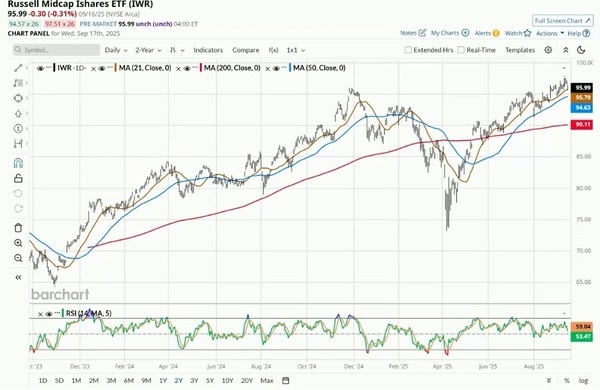
The IWR, the mid caps, have made a new high. Just on September 11, just a couple of days ago, they made a new high.
So when it comes to IWR mid cap versus IWM small cap, I’m going to say go with the IWR. Go with the mid cap, especially if you think we’re getting frothy and you think the market might turn. You definitely want to be in IWR as opposed to IWM because it’s got so many unprofitable companies that it will likely fall harder and faster if the market turns.
When it comes to small caps versus mid caps, I’m going to say longer term and for the most part, I’m going with IWR over IWM.
That’s it for today. I’ll catch you guys next week. Cheers, everybody.

Shah Gilani
Shah Gilani is the Chief Investment Strategist of Manward Press. Shah is a sought-after market commentator… a former hedge fund manager… and a veteran of the Chicago Board of Options Exchange. He ran the futures and options division at the largest retail bank in Britain… and called the implosion of U.S. financial markets (AND the mega bull run that followed). Now at the helm of Manward, Shah is focused tightly on one goal: To do his part to make subscribers wealthier, happier and more free.