OpenAI Just Handed Us Two Huge Trading Setups
Shah Gilani|October 10, 2025

September 10, 2025…
Oracle opens the day with an $87 gap higher – a 32% single-day move that would normally take six months.
Four weeks later, AMD does the same thing.
An anomaly? Hardly…
This is the new normal in the age of AI.
Oracle (ORCL) reported fiscal Q1 results after the market close on October 9. It revealed remaining performance obligations (RPO) – essentially a backlog of future business – of $455 billion, up 359% year over year.
Management guided aggressively, forecasting that its Oracle Cloud Infrastructure (OCI) business would grow 77% this fiscal year, with multiyear trajectories rising to $144 billion in later years.
But the 32.2% gap in the stock price the next morning stemmed less from the backlog itself than from its source…
OpenAI. The magnitude of the backlog signals a pivot rather than simply an earnings beat.
Fast-forward one month…
Advanced Micro Devices (AMD) closed Friday, October 3, at $164.67. On Monday, the stock opened at $226.44, up 37.5%.
The reason?
The company announced a multiyear agreement to supply AI chips in data centers it will build for OpenAI. OpenAI would also have an option to take a 10% equity stake in AMD if the company meets performance triggers.
The deal ignited expectations that AMD would become a major part of AI hardware infrastructure, not just a “nice to have” GPU/accelerator supplier.
And with both of these gaps… traders readied their moves.
Mind the Gap
Technical analysts recognize that gaps (especially large ones) carry both opportunity and built-in risk.
Market wisdom says that many gaps get filled – but the price eventually returns into the gap region.
Five factors explain this tendency…
- Overextension and euphoria. A monster gap reflects overreaction as investors rush in on news, pushing the price above logical equilibrium. But excess demand often runs out of fuel, leaving the price vulnerable.
- Lack of structure and support in the gap zone. When a stock jumps, it leaves behind a void of trading history (few or no trades) in the price interval between the pre-gap high and the post-gap low. That zone becomes a magnet. If buyers lose conviction, the stock may fall into that vacuum seeking support.
- Profit-taking and short-term selling. Big gainers attract immediate profit-takers, early entrants, short-term traders, and institutional rebalancing. That selling pressure can pull the price back.
- Skepticism and reversal of sentiment. If part of the jump stems from narrative or forward guidance rather than hard numbers, doubts creep in. The market may test whether the “sky’s the limit” assumptions hold.
- Technical inertia and mean reversion. Technical systems built for mean reversion detect momentum fade. If the stock moves too far, too fast, some technical traders short or hedge, contributing to downward pressure.
A gap up – especially a huge gap up – is never “safe” because the natural tendency is to fill the gap to some degree.
Unsettling… but Opportunistic
Filling Oracle’s gap means relinquishing a large portion of the monster move, from around $328 back down to $241. And as you can see in the chart, that’s already happening…
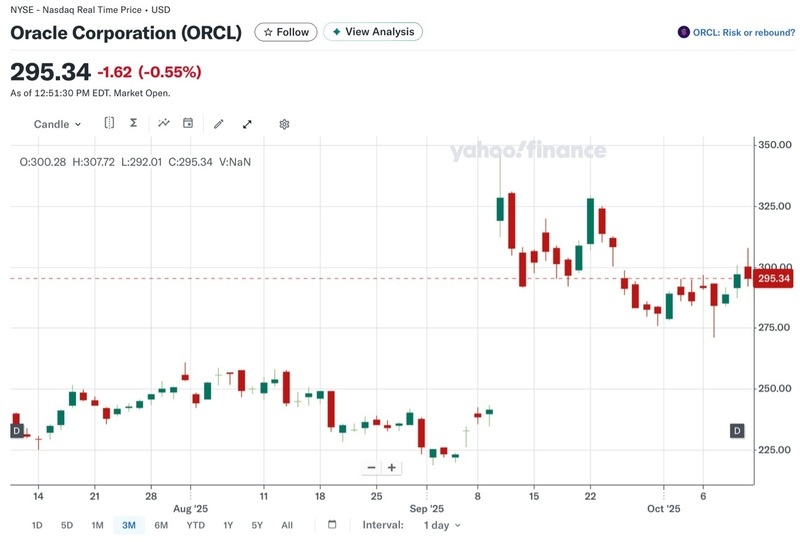
It’s an unsettling move because investors would have to concede substantial upside “airspace.” That would shake confidence among momentum and breakout traders who piled in… and unsettle the narrative behind the huge move up.
Investors would question whether the backlog and guidance were overhyped.
But any gap fill creates a potential buying opportunity.
If the gap fills and tests the lower zone (the stock’s new support) and holds, you could get in near a structural support level. That’s arguably a much better risk/reward entry.
If the narrative around cloud, AI, and infrastructure holds, the upside from that lower base remains extremely attractive.
If Oracle retraces into that gap zone and finds support, investors would be buying at a discount to a still powerful trend.
Buying the Trend at a Discount
AMD’s gap presents a similar dynamic. A fill or substantial retracement would be unsettling because a sharp pullback would erode the excitement around its OpenAI deal and raise questions about valuation, competition with Nvidia, execution, and margins. If AMD loses too much confidence, it could slide into technical weakness.
But again, if AMD dips back into the gap and holds, that’s a chance to buy into a trending setup at more favorable levels. The downside becomes more contained, and the upside remains tied to the AI infrastructure narrative.
Bottom line: These gaps signal huge opportunity – but not guarantees – of straight-line upside. Use discipline, watch for fills, and buy selectively into strength once the dust settles.
In the age of AI and cloud computing, keep these stocks on your radar. They represent structural bets, not fleeting opportunities.

Shah Gilani
Shah Gilani is the Chief Investment Strategist of Manward Press. Shah is a sought-after market commentator… a former hedge fund manager… and a veteran of the Chicago Board of Options Exchange. He ran the futures and options division at the largest retail bank in Britain… and called the implosion of U.S. financial markets (AND the mega bull run that followed). Now at the helm of Manward, Shah is focused tightly on one goal: To do his part to make subscribers wealthier, happier and more free.