Buy This, Not That: The Tale of Two Fraud-Hit Banks
Shah Gilani|October 22, 2025

When the same alleged fraudsters hit two major regional banks with identical schemes, you’d expect similar outcomes…
You’d be wrong.
One bank took a $50 million hit and got upgraded the next day.
The other faces $100 million in losses and keeps falling.
The difference? Geographic diversification and risk controls.
Bank A operates across seven states with a diversified loan portfolio.
Bank B? Concentrated in just three states – the exact markets where the fraud occurred.
In today’s Buy This, Not That, I reveal which beaten-down bank has the balance sheet strength and geographic spread to weather this storm.
The answer might surprise you.
Click on the thumbnail to discover which bank is the hidden gem.
Transcript
Hey, everybody. Shah Gilani here with your weekly BTNT, as in “Buy This, Not That.”
I received many questions about the two banks that had major issues and caused the banking sector – as measured by the Financial Select Sector ETF (XLF) and mid-cap regional bank indexes – to tank.
How will they perform in the future? Are either of them a buy? Should one outperform the other, or should you stay away from both?
This week’s BTNT is about Zions Bancorporation (ZION) versus Western Alliance (WAL).
Let me give you my analysis of each bank.
Here’s a snapshot of Zions Bancorporation’s chart.
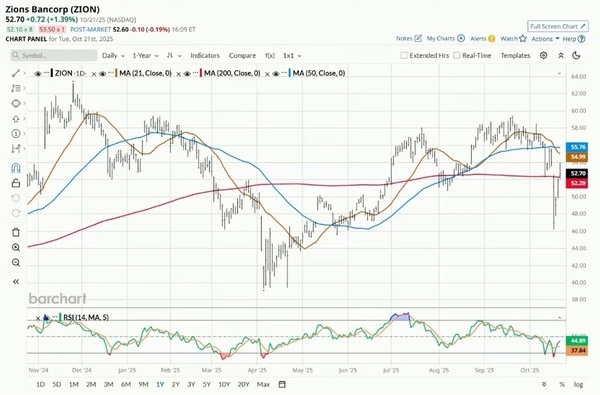
This ugly 13% drop occurred when news broke that Zions would take approximately a $50 million write-off and wanted to reserve additional money against bad loans.
The bad loans involved fraud allegations.
What generally happened – and this is a complicated, ongoing case with allegations – is that some borrowers, particularly a group of investment firms in Newport Beach, California, allegedly hypothecated collateral. In other words, they used real estate as collateral that was already pledged for other loans.
Some of the real estate in question that secured loans was in default, and some properties were in foreclosure. These are all allegations. When Zions announced it would take a $50 million write-off because of this issue, the stock took a hit.
Western Alliance’s symbol is WAL. At first glance, the charts look similar over time. But Western Alliance took a bigger hit and isn’t recovering as well as Zions.
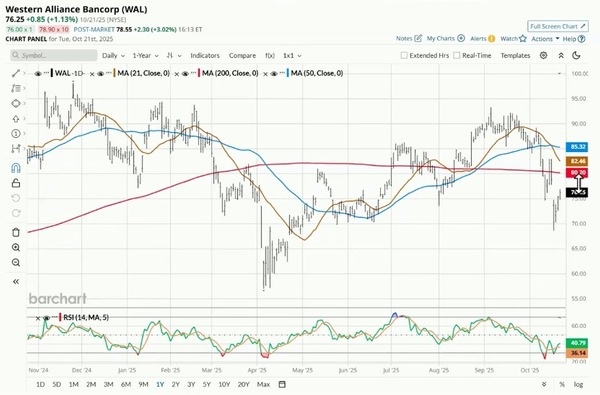
The problem with Western Alliance is it’s looking at a $100 million write-down against what are unbelievably similar circumstances to Zions’ situation. Not just similar – overlapping. Some of the investors involved in the fraud allegations against Zions’ loans are the same investors who borrowed from Western Alliance. They possibly hypothecated some of the same properties for loans that were already pledged to Zions.
We have a royal mess here. If the overlap involves both firms and the same alleged fraudsters, it’s telling that two banks were duped by the same group for similar amounts. Zions’ write-off appears to be $50 million, while Western Alliance is discussing a $100 million write-down.
Both stocks tanked, so the question is: Which one is a buy now? I’m going with Zions, not Western Alliance.
Here’s why I won’t recommend Western Alliance. Western Alliance concentrates its business in Arizona, California, and Nevada. They’re a Phoenix-based bank heavily into real estate lending. Yes, they have other commercial and industrial loan lines, but they’re primarily focused on real estate in this concentrated area. The California and Arizona properties were hypothecated.
That’s a problem for Western Alliance because the extent of the fraud appears more pervasive. More parts of the bank were involved in lending, title, insurance, and other areas related to this alleged fraud. This raises questions for me and regulators about their controls – how did they allow this to happen across multiple sectors of the bank? That makes me worried.
I wouldn’t buy Western Alliance at these levels. I certainly wouldn’t buy it for the dividend, which might be at risk because of the write-off. They should be able to handle it – it’s not a deal killer or bank-closing issue. It’s just a problem for the quarter and for regulators.
Zions, on the other hand, received an upgrade the day after from RW Baird – the day after announcing the $50 million write-down. For an investment house like RW Baird to upgrade Zions the day after suggests they have confidence that the impact will be minimal. The $50 million write-off against their large loan book is probably about 1%.
Zions won’t be badly impacted. The upgrade probably reflects support for the bank because it has a better, more diversified loan book.
Zions is based in Salt Lake City, Utah. It operates in Utah, Arizona, California, Nevada, Idaho, New Mexico, and Texas. It has a much wider, more diversified base than Western Alliance.
When it comes to these two beaten-up banks, I say Zions Bancorporation is a buy to catch a rebound, but not Western Alliance.
That’s it for today. I’ll catch you next week. Cheers.

Shah Gilani
Shah Gilani is the Chief Investment Strategist of Manward Press. Shah is a sought-after market commentator… a former hedge fund manager… and a veteran of the Chicago Board of Options Exchange. He ran the futures and options division at the largest retail bank in Britain… and called the implosion of U.S. financial markets (AND the mega bull run that followed). Now at the helm of Manward, Shah is focused tightly on one goal: To do his part to make subscribers wealthier, happier and more free.