An $800B Revenue Shortfall Investors Can’t Ignore
Shah Gilani|November 14, 2025

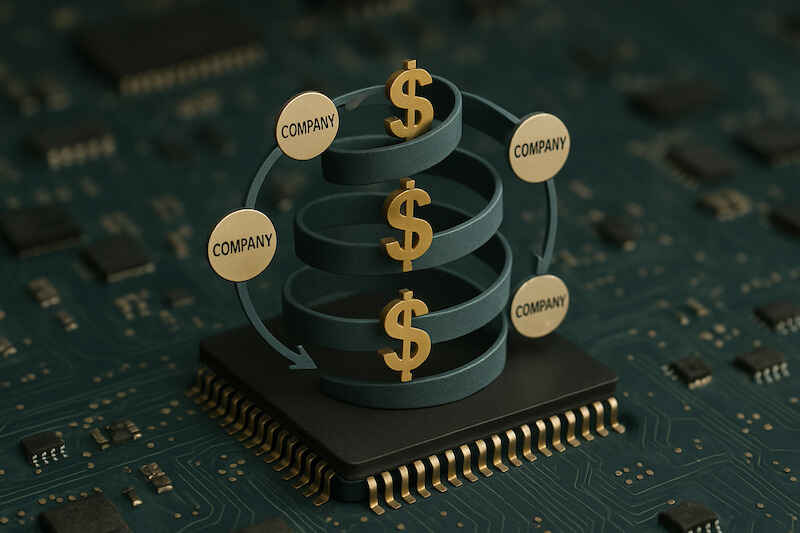
Last week, I mapped the “spiral convolution” powering the AI buildout – Nvidia funding customers who buy Nvidia chips, companies borrowing billions to build data centers no one’s committed to filling yet.
The cheerleaders will tell you this is “ecosystem investing” or “strategic positioning.” Wall Street is betting trillions on that narrative.
But let’s test it. When you actually run the numbers on revenue needed versus revenue projected, on capital deployed versus returns generated, the AI buildout starts to look less like the future and more like a very expensive bet that doesn’t add up.
The Revenue Gap
Bain & Company tried to put some numbers on this party and came up with something fun.
By 2030, AI players will need around $2 trillion in combined annual revenue just to pay for the computing power needed to meet projected demand. Their expectation? An $800 billion annual shortfall versus that requirement.
In other words, the industry is building like the revenue will be there, but the math says it probably won’t – at least not for everyone.
Hedge fund manager David Einhorn looks at those numbers and sees a “reasonable chance that a tremendous amount of capital destruction is going to come through this cycle.”
That’s a polite way of saying a lot of this stuff is never getting paid back.
The Return Problem
And that’s before you look at the “payoff” so far.
Researchers at MIT found 95% of organizations saw zero return on their AI investments.
Not low return. Zero.
Meanwhile, OpenAI projected $12.7 billion in revenue for 2025 – more than triple prior levels – and still won’t be generating cash. Yet a secondary deal giving employees liquidity implied a $500 billion valuation for a company that’s never turned a profit.
Yes, ChatGPT reportedly has around 700 million weekly users, which is remarkable growth. But eyeballs didn’t save the dot-com darlings either. Cash did.
The Dot-Com Playbook Returns
Of course, AI has its own version of the dot-com mania playbook.
Some infrastructure startups – such as Nebius, spun out of Russia’s Yandex – have inked deals worth up to $19.4 billion with Microsoft.
Smaller names – such as Nscale, which once focused on crypto mining – are now rebranding themselves as data center partners for Nvidia, OpenAI, and Microsoft across Europe.
You’ve seen this movie: the new tech wave, re-badged players from the last bubble, huge projected TAM (total addressable market), and very squishy profitability timelines.
When Reality Intrudes
And even when reality throws a brick through the windshield, the caravan keeps rolling.
When China’s DeepSeek launched a competitive model built for a fraction of what U.S. giants are spending, it triggered roughly a $1 trillion selloff in tech stocks and a 17% one-day hit to Nvidia’s share price.
The message was obvious: if competitive, low-cost models can be built on the cheap, a lot of this multitrillion-dollar infrastructure may end up supporting commoditized AI services that don’t command premium prices.
Silicon Valley shrugged. It re-upped capex plans and pushed Nvidia’s market cap back over $5 trillion. It is back to $4.5 trillion, making it the most valuable company on earth.
Bubble worries? Sure. But also FOMO.
Late-Cycle Messaging
Inside the industry, the messaging is classic late cycle.
Sam Altman says yes, investors are probably “overexcited” about AI, but also that AI is the most important thing to happen in a very long time.
Mark Zuckerberg says an AI bubble is “quite possible,” but he’s more worried about not spending enough – meaning if they “misspend a couple of hundred billion dollars,” that would be “unfortunate,” but the greater risk is under-investing.
Bret Taylor, OpenAI’s chairman, freely admits there are “a lot of parallels to the internet bubble” and that “a lot of people will lose a lot of money,” while still believing AI will create huge long-term value.
Translation: the circles will be broken and the system will collapse for plenty of players, but the survivors will do great.
Nvidia as Anchor Point
Meanwhile, Nvidia – the original player in the circular game – is busy turning its own balance sheet into the anchor point for the whole structure.
It participated in 52 AI venture deals in 2024 and had already done 50 more by September 2025. The company has said it will direct its cash to the “most strategic parts of the ecosystem,” which conveniently tend to be customers, financiers, and counterparties all at once.
It has even agreed to backstop partners like CoreWeave by promising to buy any “excess” capacity. That’s not just leverage – that’s being the anchor point for everyone else’s leverage too.
When the system is this interconnected, any break in the circle can unravel the whole thing.
The Bottom Line
Could this all work out? Sure. Some of these companies will absolutely become the next Amazons and Googles of AI. The big U.S. tech names have real earnings, big cash piles, and diversified businesses.
But make no mistake: this is a tightly wound circular structure balanced on enormous capital spending, interconnected deals, aggressive leverage, and business models that mostly exist in slide decks and scenario analyses. Spiral convolution.
If something breaks – if demand disappoints, regulation bites, power grids can’t keep up, pricing collapses under competition – this doesn’t unwind gently. It doesn’t “hallucinate” lower. The circle breaks, hard, and drags the whole stock market down with it.
Call it a circular system, call it spiral convolution, call it the future. Just don’t call it low-risk.

Shah Gilani
Shah Gilani is the Chief Investment Strategist of Manward Press. Shah is a sought-after market commentator… a former hedge fund manager… and a veteran of the Chicago Board of Options Exchange. He ran the futures and options division at the largest retail bank in Britain… and called the implosion of U.S. financial markets (AND the mega bull run that followed). Now at the helm of Manward, Shah is focused tightly on one goal: To do his part to make subscribers wealthier, happier and more free.