Buy This, Not That: How 50-Year Mortgages Will Reshape Homebuilders
Shah Gilani|November 19, 2025

The housing affordability crisis has Washington talking about a radical solution: 50-year mortgages.
Lower monthly payments could unlock millions of first-time buyers. But there’s a catch.
Banks won’t offer them without government backing. And even if that happens, not all homebuilders are positioned to benefit equally.
In today’s Buy This, Not That, I’m comparing two entry-level homebuilders – one with a $40 billion market cap and fortress balance sheet, the other a $595 million speculative play.
One has multiple brands, 10.47% profit margins, and $34 billion in revenue. The other? Razor-thin 1.92% margins and earnings down 42% year over year.
If 50-year mortgages become reality, only one of these stocks has the diversification and financial strength to truly capitalize.
Click on the thumbnail below to see which homebuilder deserves your money.
Transcript
Hey, everybody. Shah Gilani here with your weekly BTNT, as in Buy This, Not That.
Today, I’m going to focus on the potential for 50-year mortgages and how that would possibly impact two of the more noted entry-level home builders: D.R. Horton (DHI) and Beazer Homes (BZH).
But before I get into Beazer versus D.R. Horton, let me say this about that…
A 50-year mortgage is nothing to prevent. It doesn’t take an act of Congress to create 50-year mortgages. Banks just have to offer 50-year mortgages.
The reason that they don’t… well, there are a few reasons. Primarily, the really big reason that banks don’t offer them and mortgage companies don’t offer them is there’s not a way for them to offload them.
So if banks make mortgages with 50-year duration, you get a 50-year mortgage and that bank holds that paper, they have to hold that for 50 years. With 30-year mortgages and all kinds of other mortgages, on the other hand, they’re able to package those and sell them to investors in the form of securities, known as mortgage-backed securities. The mortgage-backed security market is so worthwhile and effective at circulating more mortgage money because the government backs these securities.
There are certain levels where the government will back them. Without going into the reasons and Freddie and Fannie Mae and all that stuff, suffice it to say that investors buy these mortgage-backed securities because there’s a sense that the government will back them. Though that isn’t really the case anymore. But that is sort of the expectation.
There is no government program to back mortgages of 50 years. So if banks offer 50-year mortgages and they package them, investors still could buy them. But that’s a lot of risk for investors to take on something that has a 50-year duration.
In other words, you have to wait a long time. Yes, you get your interest. But you’ll wait a long time to get your principal back. If the government is going to somehow back those 50-year mortgages, and then you can trade them and move them around and get in and out of them, then that makes them a lot more palatable for investors. And it means that banks and other mortgage lenders will be more likely to offer 50-year mortgages.
So we’re not there yet. Can we get there?
It’s going to take a government response to do it. So shy of that, the banks aren’t on their own likely to do it because I don’t think the demand is there from investors.
But for home buyers, potential home buyers, especially less wealthy, less heeled home buyers, entry-level home buyers, lower-end homes – the likes of which D.R. Horton and Beazer construct and sell – yes, they would be interested because a 50-year mortgage means lower payments. It doesn’t mean that it’s cheaper in the long run. It’s actually a lot more expensive to pay that much interest over that many more years.
You’re paying a lot more for that house, but it does lower payments on a monthly basis.
And that’s the affordability angle of it. And believe me, it’s an angle. So when it comes to D.R. Horton versus Beazer, let’s just pull up some charts and I’m just going to give you an idea of what they look like.
And it’s not that easy a choice, but I’m going to make it easy for you.
So first of all, let’s take a look at D.R. Horton. Now D.R. Horton is much, much bigger than Beazer Homes. It has several different brands. The Express brand is more entry-level. It has quite a few entry-level brands. And we’re talking about entry-level, talking about smaller floor plans, lower price point homes.
And D.R. Horton does a really good job of building communities with those lower-priced homes. So a very well-run company, but the stock has been all over the place.
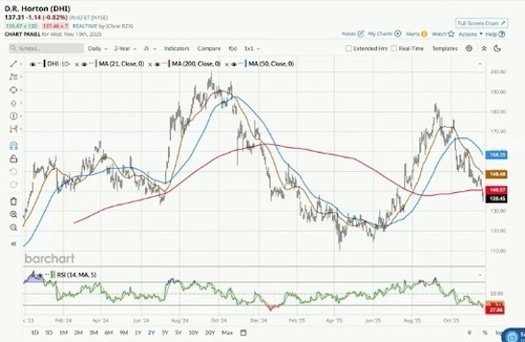
This is a two-year chart. It looks like a roller coaster. Is it coming down here? Possibly again, yeah. We know that the housing market is tough and interest rates are elevated. Will 50-year mortgages help?
The idea is that they will, and they will spur homebuyers, especially entry-level buyers. So D.R. Horton pretty big – $40-plus billion market cap, revenues $34.25 billion over the trailing 12 months. Profit margin 10.47%. So yeah, pretty good company as far as size, as far as profitability.
And this is typical of home builders right now. The quarterly revenue growth year over year is minus 3.2%. The quarterly earnings growth over the trailing 12 months is minus 29.5%. Great balance sheet and relatively cheap on a P/E basis. So I like DHI here because I think they have more product to offer. And I think it’s a larger, better-run company than Beazer. And it’s just got a better balance sheet.
Now Beazer is interesting because if you really want to play it tight, like, my goodness, if we get 50-year mortgages and that really spurs first-time homebuyers, then Beazer might have a heck of a shot. It’s a very small company – $595 million market cap. It’s small, people. Revenue $2.37 billion. That’s pretty decent revenue given this capitalization.
Profit margin is pretty thin at 1.92%, and their quarterly revenue growth year over year minus 1.8%. Their quarterly earnings growth year over year, negative 42%. So going in the wrong direction. Now this chart doesn’t have the kind of bounce that DHI had.
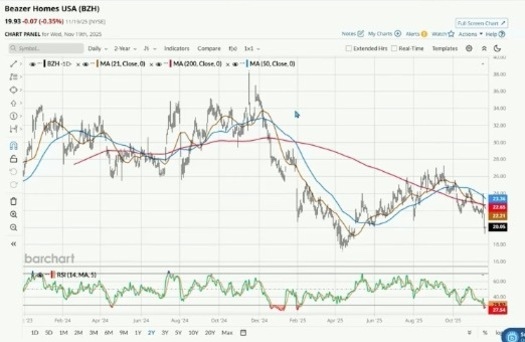
So as far as BZH here, it’s kind of been knocked down. It looks like it’s going to maybe test these lows, maybe it’ll find some support. As far as a play on 50-year mortgages, Beazer might see some buying. There might be some interest in that if we get 50-year mortgages to become status quo, and you can get them and people look for them, and then that spurs homebuilding and home sales in the $200,000 to $400,000 home price range, then Beazer would do well.
But I still think given DHI’s larger footprint, more brands, greater diversification, and much better balance sheet on a lot of levels, then I’m going to go with DHI. But for those of you who like to speculate a little bit, Beazer could be an interesting speculative play. But as far as BTNT goes, I would buy D.R. Horton and not Beazer. I’ll catch you guys next week.
Cheers.

Shah Gilani
Shah Gilani is the Chief Investment Strategist of Manward Press. Shah is a sought-after market commentator… a former hedge fund manager… and a veteran of the Chicago Board of Options Exchange. He ran the futures and options division at the largest retail bank in Britain… and called the implosion of U.S. financial markets (AND the mega bull run that followed). Now at the helm of Manward, Shah is focused tightly on one goal: To do his part to make subscribers wealthier, happier and more free.