
Shah Gilani's Archive

Shah Gilani
Wall Street superstar and former hedge fund manager Shah Gilani is the Chief Investment Strategist of Manward Press and at the helm of the Manward Money Report newsletter and the Launch Investor and Alpha Money Flow trading services. He’s a sought-after market commentator and has appeared on CNBC, Fox Business and Bloomberg TV. He’s also been quoted in The Wall Street Journal, The New York Times and The Washington Post, and he’s had columns published in Forbes.
In 1982, he launched his first hedge fund from his seat on the floor of the Chicago Board Options Exchange. He worked in the pit as a market maker when options on the S&P 100 Index first began trading… and was part of a handful of traders who laid the technical groundwork for what would eventually become the CBOE Volatility Index (VIX). He also ran the futures and options division at the largest retail bank in Britain. Shah gained notoriety for calling the implosion of U.S. financial markets (all the way back in February 2008) AND the mega bull run that followed.
Now at the helm of Manward, Shah is focused tightly on one goal: To do his part to make subscribers wealthier, happier and more free.

Don’t Buy Increasing Predictions of a Recession: Do This Instead
More analysts, economists, and former Federal Reserve officials are predicting a recession – one that will stagger the U.S. economy. That’s frightening investors into selling profitable positions and going to the sidelines.
I say they’re wrong, and getting out of the market now is a mistake, and I’m telling you why in today’s edition of Total Wealth.
Buy a Slice of this $300 Tech Stock at Any Price
This company is one of my favorites. It’s a mega cap company with a capitalization over $2 trillion. Its revenue on a trailing-twelve-month basis is $185 billion. Its profit margin is 38.5%… and it’s still growing. There is no reason not to own this stock. Well, maybe there is. Not everyone can afford to spend […]
Use this Strategy to Reap 100% Profits as These Two Stocks Drop
I said it once; I’ll say it again: inflation has not reached its peak.
While some investors and traders are piling back into the stock market – misguided by news claiming that March’s sky-high inflation measures were as bad as inflation would get – veteran companies watching the markets won’t be so reckless.
That’s one of the reasons I’m watching The Coca-Cola Company (KO).
The company will report Q1/2022 results on April 25. As we get closer to that date, the stock has been in an almost perfect upward trend, gaining 14% since March 10, 2022.
For the quarter, analysts expect Coca-Cola to report revenue and earnings of $9.82 billion and $0.58 per share, which would represent year-over-year increases of 8.9% and 5.45%, respectively.
Based on the company’s history, I expect it will beat estimates.
But, I’m focused on forward guidance and whether or not the company believes it can pass along higher input costs to the consumer.
I think the company will err on the side of caution and tamp down forward guidance in the face of inflation that’s running very hot.
And I think that could cause a pause in the recent rally – and present us with our next play.
Your Latest Buy, Sell, or Hold Now Available (Transcript Inside)
This week, Twitter, Delta, and JP Morgan Chase have all been in the spotlight – and many of you are asking: What should we do with these stocks? Buy? Sell? Or hold on to our shares? Well, in today’s BS.H, I answer just that. Click the video below to watch my full analysis of each […]
The Latest in Fake News: Inflation Has Peaked
On Tuesday, when the March reading of the headline Consumer Price Index (CPI) came out hot, but a tad less than jacked up expectations, stocks rallied. On Wednesday, when the Producer Price Index (PPI) came out hotter than hot, stocks jumped higher. Why? Well, the crazy reason is traders and investors are following a ridiculous […]
Plant Your Love and Let It Grow with this Fertilizer Stock
Fertilizer prices are through the roof.
According to the USDA, over the past year, urea, liquid nitrogen, and anhydrous ammonia (three kinds of commonly fertilizers) grew 149%, 192%, and 235%, respectively. For farmers worldwide, this unexpected consequence of the Russia-Ukraine War has a steep cost – but they will pay it.
Why? Because they have no other choice. They need it and, as a result, fertilizer companies are hitting it out of the park, especially the one I am recommending in today’s video.
Click the video below to learn how to play CF Industries, or click here to read the transcript.
Russian Threat to U.S. Cyber Security Will Send This Company into Hyperdrive
With sanctions on Russia ramping up, security experts warn that a retaliatory cyber-fight could be coming to the West. Whether or not a full-blown cyberwar with Russia ever materializes doesn’t matter from a short-term trading perspective. All that matters is the cyber threat narrative driving stocks higher. Case in point, the iShares Cybersecurity and Tech […]
Don’t Fall for Fake News About the Inverted Yield Curve
Claims that we’re 100% heading into a recession (because the never-wrong inverted yield curve says so) are fake news. This time the recession indicator is wrong.
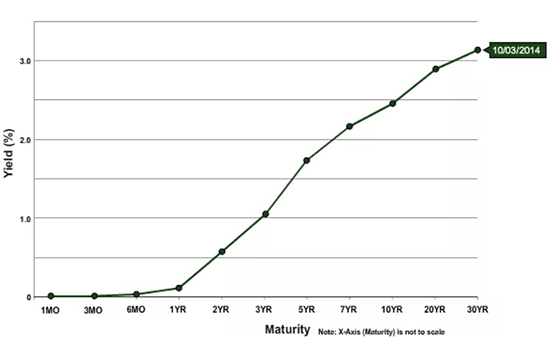
The yield curve is a simple concept. It shows graphically what different maturity bonds pay investors in terms of the yield (or interest rate) they pay.
Super short maturity instruments, like the fed funds rate (the interest rate banks charge each other when they lend money), yield very little because the loan is only overnight. The risk of default in a day is infinitesimally small. The yield on a 6-month T-Bill would be higher due to investors lending money to the government for 6-months also wanting more interest. The yield on a 2-year Treasury note would be higher because of the longer maturity of the loan. The 10-year yield would be higher still. And so on, out to 30-year bonds.
When graphed, these yields typically slope upwards like the Treasury yield curve shown below.
The yield curve is said to be inverted any time the yield on a shorter-dated maturity is higher than a longer-dated maturity instrument – in other words, a reversal of the chart above. What everyone’s panicking about was an inversion of the U.S. Treasury 2-year note and U.S Treasury 10-year bond (referred to as the 2s and 10s in Wall Street Parlance).
Over the past 30-days, the yield curve (as measured by 2s and 10s) has inverted a couple of times. At some points, this inversion was only by a few points or a few tenths of a percent, but an inversion nonetheless.
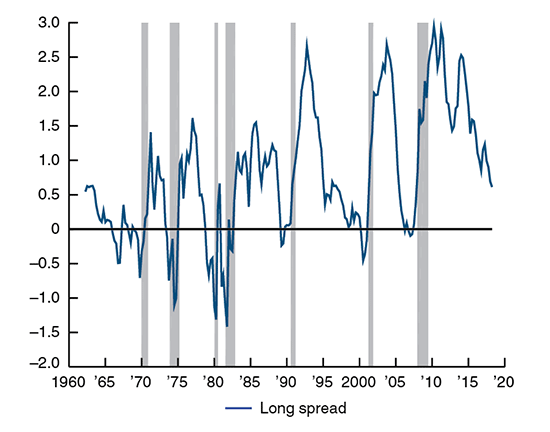
And this is concerning to some because, historically, whenever the curve inverts (even by a tiny amount), a recession follows. That’s what’s making headlines now.
The graph below shows the spread between 2s and 10s in the blue line. Whenever the spread goes negative, a recession (the gray longitudinal bars) occurs. So, it’s been a pretty good indicator so far.
But dare I say, “this time is different.”
Click here to learn why and how to position yourself to play what’s really happening.
China is ‘Uninvestable’? Not When This Tech Stock Has a 100% Profit Potential
Last year, some analysts condemned Chinese stocks listed on U.S. exchanges as ‘uninvestible.’ But I didn’t buy that claim. Yes, Chinese regulators had sent a clear message to those companies: You can’t do anything we don’t want you to do. You can’t share data with anyone we don’t want you to. And if you do, […]
Ride High on These Three Chinese Stocks As Retail Drives Them Higher
It has been two years since then-U.S. President Donald Trump vowed to hold foreign companies accountable, demanding audited financials from all companies listed on U.S. exchanges – including the Chinese ones which, until then, didn’t have to submit audited financial and never did.
The response to this policy became a “cold war” fought on the front-lines of securities trading. High-quality stocks like BABA, DIDI, and NIO, some of my favorites to come out of China, were beaten down. IPOs were postponed. But, regardless of Chinese Central Government’s retaliation, the deadline was set.
All non-compliant businesses would be removed from the New York Stock Exchange and Nasdaq by 2024 – and it seems that Chinese authorities have started to give in.
On Friday, investors learned that they are preparing to give U.S. regulators full access to auditing reports of the majority of the 200-plus companies listed in New York, as soon as this Summer.
There’s no way of knowing how serious Chinese authorities are, regarding the matter, but that didn’t stopped traders from driving shares of Chinese stocks higher in Friday’s session.
Given the fact that Chinese stocks have been significantly beaten down over the last 18 months, I think we have a pretty good short-term trading opportunity to catch a ride as retail traders look for new trades.