Buy This, Not That: Should You Chase Amazon’s Gap or Buy Microsoft’s Dip?
Shah Gilani|November 5, 2025

Amazon just gapped up on cloud earnings.
Should you chase it?
Or is Microsoft’s sideways action the real opportunity?
I’ve been getting this question all week, so let’s settle it once and for all.
AWS brought in $33.02 billion last quarter. Azure pulled $30.98 billion.
But here’s where it gets interesting…
Operating margins: One is in the mid-30s. The other is in the low 40s.
Year-over-year growth: One is at 20%. The other is at 40%.
When you put all the pieces together – revenue, margins, growth rates, and chart patterns – only one of these cloud giants makes sense as a buy right now.
In today’s Buy This, Not That, I show you exactly which one… and why.
Click on the thumbnail below to watch.
Transcript
Hey, everybody. Shah Gilani here with your weekly BTNT, as in Buy This, Not That. I got more than a few questions about my preference – whether I would buy Amazon or Microsoft based on their cloud business. So let’s do a side-by-side comparison of Microsoft’s Azure cloud and Amazon’s AWS, as in Amazon Web Services. Both of them are gigantic. I’m going to pull up some stock charts while we’re talking about these.
Amazon beats out Microsoft as far as cloud goes. And that’s because their segment revenue – Amazon’s AWS segment revenue for the AWS cloud – is $33.02 billion over the last quarter.
Microsoft Intelligent Cloud, the Azure, is $30.98 billion. So segment-wise, as far as the cloud in general and revenue and actually size of the cloud in terms of its reach, AWS beats out Microsoft Azure cloud. So now what’s more important probably are the growth prospects for the cloud. As far as the latest quarter results, Amazon’s AWS cloud is showing a 20% year-over-year gain. Now that was enough to move the stock considerably higher.
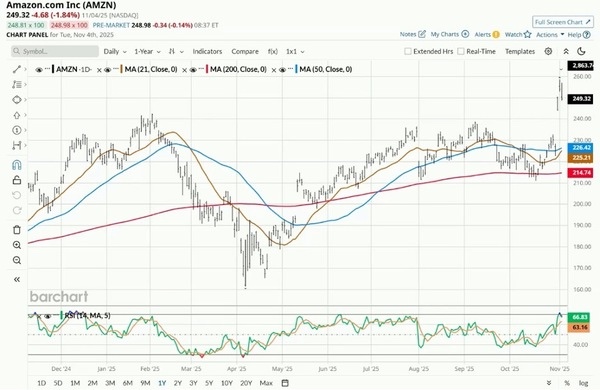
Everyone really liked that. And investors like the fact that cloud’s really growing.
That’s the high-margin business for Amazon. Definitely cloud. Microsoft had better growth prospects – 28% year-over-year on their Intelligent Cloud. Now, Azure, and they break it down differently, Azure and the other cloud services, because don’t forget, the Azure cloud represents the offering and the calculation area and all of this cloud capacity for everything that happens in all of Microsoft’s enterprise products across the spectrum.
So there’s a lot that goes on there and contributes a lot to the revenue there. So their year-over-year growth in the total cloud picture, including other cloud services, was 40%. That is double what AWS’s year-over-year cloud growth was. So that handily goes to Microsoft.
But Microsoft, I’m going to show you in a second, doesn’t have this kind of price action based on its earnings and based on its cloud. And that’s because in the bigger picture, people are now focusing on Amazon’s 20% growth year-over-year in cloud, because of the margins versus Microsoft margins, which are a little more consistent, where Amazon’s largest margins by far come from the cloud as opposed to sales on the platform. So that’s what investors are looking at when they’re looking at growth. They’re looking at the cloud growth and that’s obviously a function of AI build out, et cetera.
So yeah, that makes sense that the stock popped on that.
Now as far as segment income, $11.4 billion for AWS was their operating income for the quarter. It was $13.3 billion for Microsoft. So it gets actually more cloud income than Amazon does.
Year-over-year operating income for the AWS cloud was up 10%. For Microsoft, up 27.5% year-over-year.
The implied operating margins, we’re looking at the mid-30s for AWS. So this is the important part here. So mid-30s for AWS, and we’re talking low 40s for Azure cloud. So it’s better margins for Microsoft’s cloud than there are for Amazon.
But Amazon’s pretty darn good. So AWS is almost all infrastructure and services now. The Intelligent Cloud for Microsoft includes the Azure plus, again, like I said, the server products, the enterprise services stuff. So AWS is slightly higher by revenue, but Microsoft’s Intelligent Cloud is flat out growing faster.
But the stock is a question of, wow, the investors reacted really well to Amazon here. You have this big gap up here. And with Microsoft, Microsoft has been languishing here and it’s been languishing for some time, kind of sideways action here. And here’s what I’m talking about.
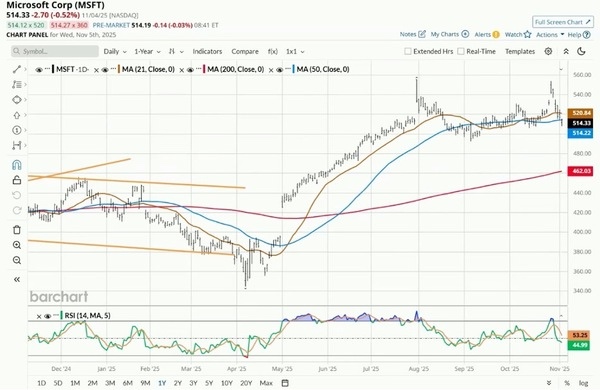
Big gap up here. When you see a company this size have a gap up here and continue to rise, that’s pretty powerful stuff. But it’s been going pretty flat and now it’s been coming down. So whether to buy Microsoft for its cloud or Amazon for the cloud, I’m going to say Microsoft only because I think their growth is better and I think that their margins remain better and I think they will expand those margins over time because of the enterprise software and everything else that they do having to do with Microsoft product offerings.
So I like Microsoft longer term here, but I would not sell Amazon. I would definitely own Amazon. But if I had to pick today, one based on just cloud, I would buy Microsoft down here. I’d also like to buy it a little bit on a dip as opposed to chasing Amazon higher because investors just ran it up there based on the cloud growth.
So, yeah, we’ve already seen it. It’s already out there. It’s in the price. For my buck right here, if I was to choose, if I didn’t own either one of them – and I own both – I would choose Microsoft here over Amazon strictly for the cloud.
That’s it. I’ll catch you guys next week and have fun out there. Cheers.

Shah Gilani
Shah Gilani is the Chief Investment Strategist of Manward Press. Shah is a sought-after market commentator… a former hedge fund manager… and a veteran of the Chicago Board of Options Exchange. He ran the futures and options division at the largest retail bank in Britain… and called the implosion of U.S. financial markets (AND the mega bull run that followed). Now at the helm of Manward, Shah is focused tightly on one goal: To do his part to make subscribers wealthier, happier and more free.