Your Last Defense Against the Government’s War on Your Wallet
Robert Ross|August 11, 2025

“It’s not about price… it’s about freedom.”
There’s a quiet war playing out in our financial system.
It’s not about interest rates or inflation… it’s about control.
And if you’re paying attention, you’ll see the lines being drawn more clearly every day…
On one side, governments around the world are pushing for more centralized oversight.
And on the other, a decentralized movement fighting to preserve individual freedom.
At the heart of that battle is crypto.
The De-Banking Problem Is Real
Just ask Nigel Farage.
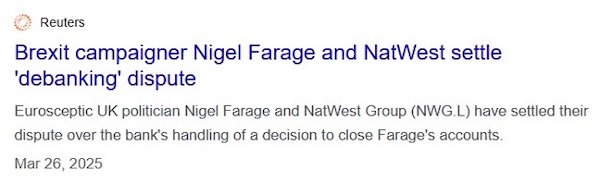
Last year, the British politician and broadcaster revealed that his bank had abruptly closed his accounts. Not because of fraud or financial misconduct, but because of his political views. Internal memos revealed the bank didn’t like his stance on Brexit or his connection to conservative movements.
It was a financial hit job.
And it’s not an isolated incident.
We’ve seen similar moves in the U.S. – from PayPal freezing accounts over “misinformation” to banks quietly cutting ties with gun manufacturers and politically controversial businesses.
Whether you’re left, right, or somewhere in between, the message is the same: if your views don’t align with the prevailing narrative, you might find yourself locked out of the financial system.
This isn’t just censorship of speech. It’s censorship of your wallet.
When Money Becomes a Weapon
The most chilling example came during Canada’s 2022 trucker protests.
Thousands of working-class citizens protested vaccine mandates and lockdowns by organizing a convoy to Ottawa. They weren’t looting stores or burning buildings. But their protests embarrassed the government.
So the Canadian government responded – not with dialogue or debate – but with bank freezes.
Using emergency powers, Prime Minister Trudeau authorized banks to freeze the personal and business accounts of protesters. No charges. No trials. No recourse.
It was a crystal-clear signal: in the digital age, governments don’t need to throw you in jail to silence you.
They just need to cut you off from your money.
CBDCs: The Ultimate Control Tool
And now governments are pushing for even more power through central bank digital currencies (CBDCs).
Proponents claim CBDCs will make payments more efficient and inclusive. But let’s be honest: CBDCs give governments the ability to track, limit, and even reverse your transactions in real time.
Want to donate to a politically “unapproved” cause? Blocked.
Want to spend your money on red meat, gas-powered cars, or too many plane tickets? Restricted for the “climate.”
It’s programmable money controlled by the government. And that’s terrifying.
Unlike physical cash, which is anonymous and permissionless, CBDCs offer no privacy and no escape. In the wrong hands (and let’s face it, that’s most hands), they become tools of behavioral control.
Bitcoin: A Sovereignty Coin
That’s why crypto – especially Bitcoin – isn’t just about speculation. It’s about sovereignty.
Bitcoin doesn’t care who you are, what party you vote for, or what opinions you hold. It runs on math, not mandates. And it offers something the traditional system no longer guarantees: financial self-custody.
You hold your keys. You hold your money.

No bank can freeze it. No bureaucrat can censor it. No central authority can inflate it away.
For libertarian-minded investors, Bitcoin is the modern equivalent of gold. Only this time, it’s gold that’s portable, programmable, and infinitely harder to confiscate.
Decentralized Alternatives Are Already Here
Beyond Bitcoin, we’re also seeing the rise of entire decentralized financial ecosystems -protocols like Chainlink (LINK) and Solana (SOL) – that are building infrastructure outside the reach of legacy institutions.
Chainlink provides the “truth layer” for smart contracts. That means it lets applications access real-world data without relying on a centralized source.
Solana is building a scalable network for decentralized apps, from finance to gaming to media, all without gatekeepers.
And while Circle (CRCL) – one of the largest IPOs of 2025 – operates a centralized stablecoin called USDC, it’s also pushing back against CBDC dominance by offering dollar access without requiring a Fed-issued token.
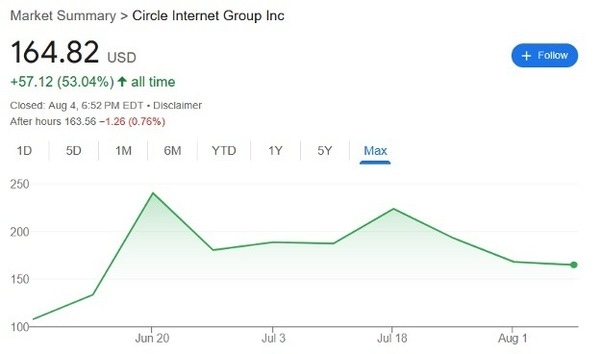
In short, it’s giving the market a choice – and that’s a good thing.
The Choice Before Us
I’m not saying the government is evil or that all regulation is bad.
But history is clear: when people surrender too much power, it rarely ends well.
That’s why crypto matters.
Not because the price might go up next week. But because it offers a parallel system… one rooted in code, not compliance.
A system where your wealth is yours… not at the mercy of a bureaucrat, a politician, or a central bank.
It’s not about getting rich overnight. It’s about opting out.
Because in an era of financial surveillance and centralized control, crypto might be the last bastion of free markets.
And that’s worth defending.