Buy This, Not That: This Durable Goods Winner Could Fill a 15% Earnings Gap
Shah Gilani|August 27, 2025

Yesterday’s durable goods report delivered a number we haven’t seen since the pandemic’s darkest days.
Durable goods orders plunged 9.3% in June – the worst reading since April 2020, when the economy was in free fall.
While July’s numbers came in “better than expected” at -2.8%, that’s still negative. And it’s masking a tale of two very different sectors…
One sector is getting absolutely hammered – commercial aviation orders crashed 9.7% as the industry’s biggest player battles supply chain nightmares and looming tariff troubles.
But another sector is quietly surging. Electrical equipment and appliances jumped 2%, creating an opportunity in a stock that just suffered an earnings “miss” – leaving a 15% gap that could fill fast.
The best part? This industrial powerhouse has a 10-year chart that makes the aviation giant’s look like “a whole lot of nothing.”
I’ll show you exactly which stock to buy and which to avoid in today’s Buy This, Not That.
Click on the thumbnail below to dive in.
TRANSCRIPT
Hey, everybody. Shah Gilani here with your weekly BTNT, as in Buy This, Not That.
Now, durable goods orders came out yesterday. And while they were better than consensus estimates, they still came in negative.
The forecast was for durable goods orders to be down 3.8% quarter over quarter. They were down 2.8%. So yes, better than expected, but still negative.
By the way, the previous month for June, durable goods orders were down 9.3% from the previous month. That’s the lowest level for durable goods orders, the worst, most negative number we’ve seen since April of 2020.
Yes. The steepest, ugliest part of the pandemic.
So to see a negative 9.3% print on durable goods last month was pretty scary. And again, analysts were expecting a negative print of negative 3.8%, but we got negative 2.8%. So better than expected, but still negative.
Hopefully, we’re going to continue to go in the right direction here. But the breakdown of the different components is most important as far as the overall number goes. You want to look between the numbers.
The really big drag was commercial aviation.
And transportation got hit really hard. Transportation orders got absolutely hammered.
Non-defense excluding aircraft was up 1.1%, but transportation overall was down 9.7%. With the bulk of that coming from commercial aviation orders, commercial aircraft orders. So commercial aircraft orders absolutely in the tank.
The best performing was electrical equipment and appliances, up 2%. So I’m going to take one of the components from the durable goods – companies that make up the whole array of numbers comes from all the companies that they check in with.
On the electrical equipment side, I’m going to choose Emerson Electric (EMR).
Emerson Electric, for those of you who don’t know: HVACs, industrial automation, control systems, big company.
I’m going to compare that to the sector that got hammered, which was commercial aircraft, and I’m going to obviously pick on Boeing (BA) for that.
So I’m going to start off by kind of giving it away that you’re going to want to buy Emerson Electric and not Boeing, but it’s not that simple.
So let me take a quick look at some charts while I’m giving you some numbers, because Boeing’s earnings beat. And while the earnings, in my opinion, weren’t great, they were still a beat, and let’s pull up Boeing first.
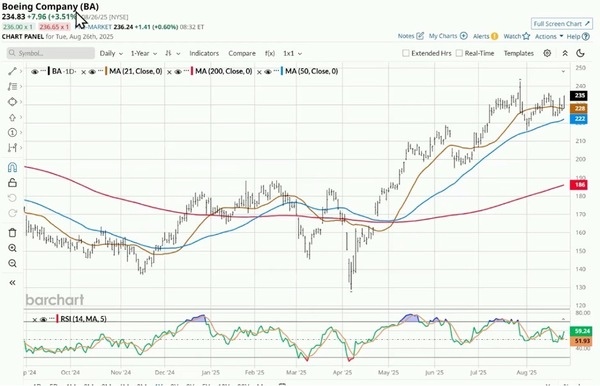
The thing about Boeing is the loss they had last year. They reported on July 29, and you can see they had this big pop right here. Big pop. So that pop was on account of the fact that the net loss came in at $176 million for the quarter.
Now a year ago quarter, they had lost $1.09 billion. So the market liked that initially, the stock popped. It opened up at $239. The previous day, they closed at $236.
So this bar here, big jump, they got all the way up to $242 on the 29th, but it closed almost on the low of the day all the way down at $226.08.
So after looking through the report and digging in and listening to management, investors decided no. Not ready to buy Boeing here. Even though it’s had a heck of a run-up, it looks pretty good, and it made that intraday high on the earnings date.
But the problem here again was they still have a net loss. Analysts are looking for tepid earnings growth in the future.
Yes, they have the big jump – the backorders, $522 billion of backorders for aircraft. They’re going to try and increase the aircraft output from 38 Dreamliners to 40, trying to get clearance to do 42 a month. So they’re doing well.
But you have a problem. Chinese pushback based on the trade situation. The Chinese said we’re not going to take any more Boeing aircraft deliveries. They then started to pick that up again in June.
Boeing has problems as far as its supply chain, and that’s a problem with tariffs because steel and aluminum tariffs are going to impact Boeing. Parts are going to impact Boeing. Construction of certain parts of Boeing aircraft that aren’t happening in the U.S., and components that are going to be tariffed.
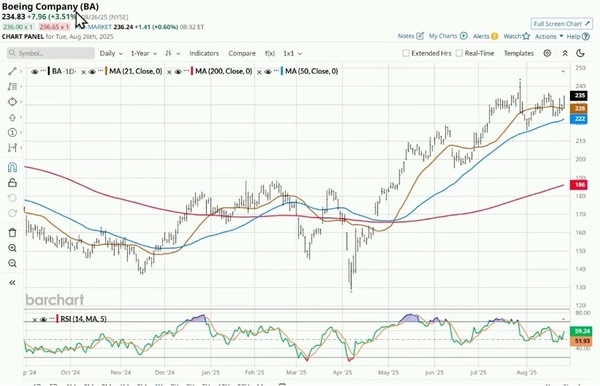
So Boeing is going to see some problems going ahead. I don’t think it’s in the clear. So to me, it’s not really a buy. Here’s the one-year chart.
Here’s the two-year chart.
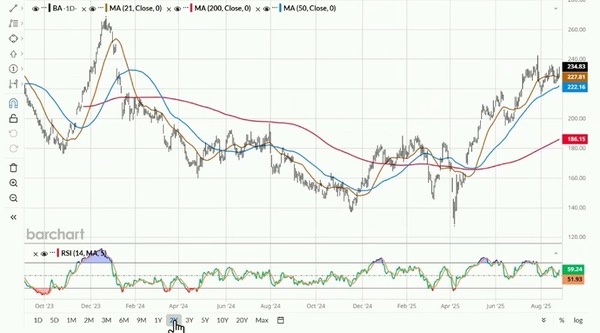
That doesn’t look very exciting to me, people. So maybe we can get back up here to the $268 to $270 range. But if you look at a five-year chart, it’s a whole lot of nothing.
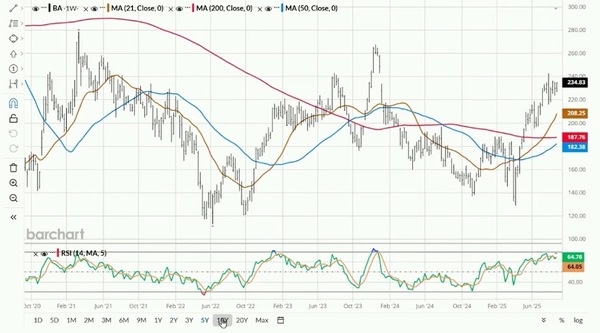
If you look at a 10-year chart, would you really want to buy that?
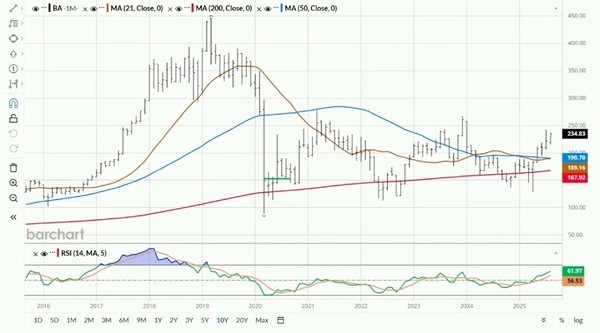
I mean, there are plenty of places that are better. And as far as durable goods goes – and by the way, durable goods are goods that are expected to last three years or more – let’s take a look at Emerson Electric.
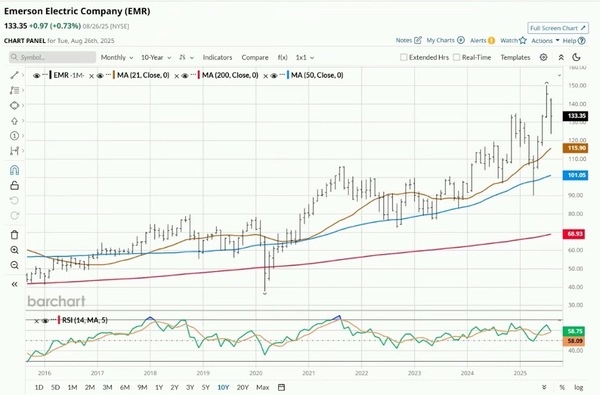
Again, HVAC, industrial automation, control systems, et cetera. Here’s the 10-year chart for Emerson Electric. A heck of a lot better than Boeing’s chart.
The one-year chart also – now they missed on earnings, hence this gap down here.
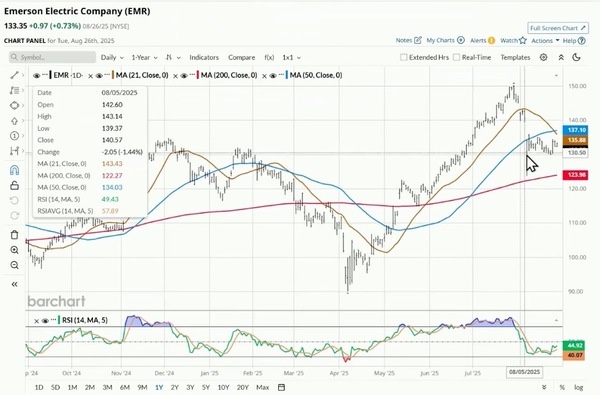
That was an earnings miss. So earnings for Emerson Electric were a bit of a letdown, and the earnings per share came in slightly better at $1.52 versus analyst estimate for $1.51.
But the problem was revenue came in for the quarter at $4.55 billion, and the estimate was for $4.6 billion. So the stock took a tumble on that.
But the revenue miss is one thing, but quarter-over-quarter yearly revenue was up 3.9%. So they did see revenue growth. Because this wasn’t as robust as analysts had expected, the stock took a beating on account of that. They guided fairly decently forward. Expectations are for pretty good numbers going forward.
So I think Emerson is a much better play here. You’ve got this gap to fill, and you’ve got pretty good potential for a nice move back north here. So as far as durable goods goes, the winners were electrical equipment and appliances, and the losers were commercial aircraft. So buy Emerson Electric and not Boeing.
I’ll catch you guys next week. Cheers, everybody.

Shah Gilani
Shah Gilani is the Chief Investment Strategist of Manward Press. Shah is a sought-after market commentator… a former hedge fund manager… and a veteran of the Chicago Board of Options Exchange. He ran the futures and options division at the largest retail bank in Britain… and called the implosion of U.S. financial markets (AND the mega bull run that followed). Now at the helm of Manward, Shah is focused tightly on one goal: To do his part to make subscribers wealthier, happier and more free.