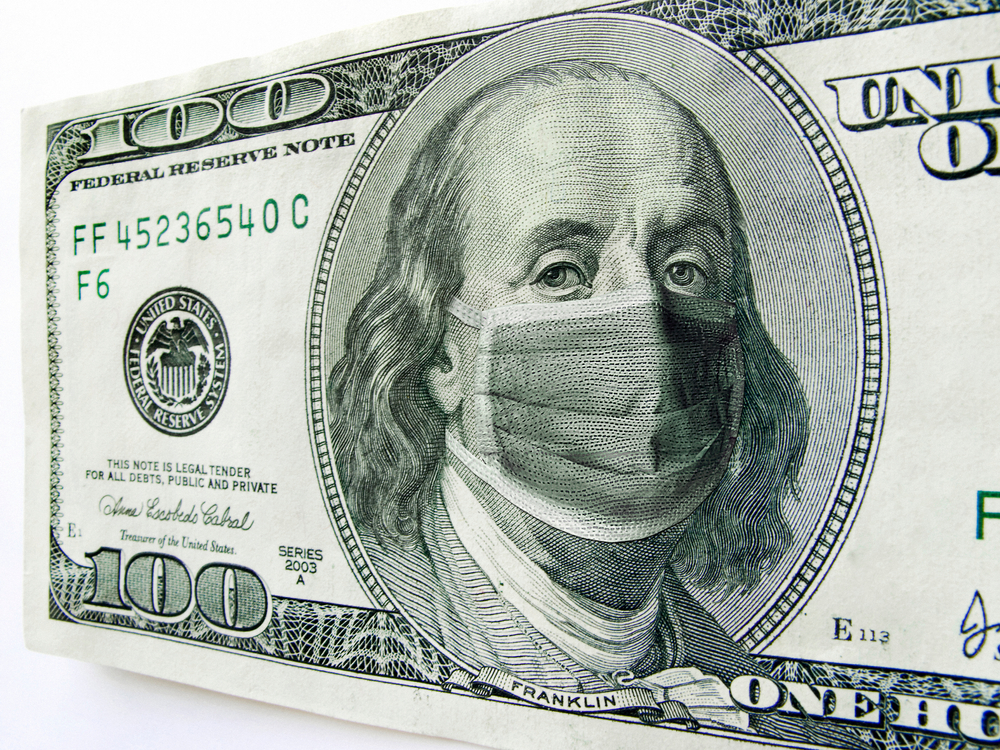
The Corona Economy: Will America Survive It?

New York City is losing billions in tax revenues, and Mayor Bill de Blasio is going to have to lay off thousands of city workers. He is upset about this. He’s calling on the Trump administration to bail out the city. “We can’t do anything about this,” he pleaded. (I’m paraphrasing.) “Only the federal government has the power to help us.”

Many in my family feel that we should keep the economy shut down “for as long as it takes.” They also say that the federal government should keep cranking out financial aid “for as long as it takes.”

“Human life is more important than money,” they say.

The trouble with mixing ethics and economics is not that they are incompatible. Quite the contrary, they are inextricably linked. The problem is that if you talk about them simultaneously, you never get anywhere.

Both subjects are important. Neither is dispositive or scientific. But economics has the advantage of a vocabulary of facts and a language of numbers. Thus, if you want to have the conversation about both, it’s better to start with the facts and numbers.

So let’s do that.

  • After crushing demand, the federal government’s $350 billion small-business relief fund ran out in less than two weeks. This week, the Small Business Administration began accepting new loan applications for an additional $310 billion in forgivable loans, with new rules in order to expand the initiative’s reach. (Though the agency’s electronic filing system crashed within minutes of the program reopening.)
  • The total “relief package” already enacted will cost about $2 trillion. There is good reason to believe that we will have a second and perhaps a third one at that same level.
  • We learned that 3.8 million more Americans lost their jobs last week – which means that the virus put around 30 million out of work within six weeks.
  • There are about 127 million households in America earning, on average, about $150,000. (That’s the mean, which counts the rich people. The median income is $60,000.) Ten million unemployed, multiplied by, say, $100,000, is $1 trillion. At an average tax rate of 20%, that’s $200 billion in lost federal tax revenues.
  • Tens of thousands of small businesses, representing hundreds of billions of dollars in tax revenues, have been shut down. Many of them will not reopen.
  • For some years now, the federal government has been running at a deficit of about $1 trillion a year.
  • Total U.S. debt is nearing $24 trillion and rising fast.

Would You Invest in This Company?

Think of the federal government as a business. I know that it’s not a business, nor is it intended to be. But hear me out.

You are an investor, trying to decide whether you want to buy this company.

The first thing you do is look at a spreadsheet of the financials – a P&L (profit and loss) statement and a balance sheet (assets minus liabilities).

You look first to the bottom line of the P&L, which tells you how profitable this company is. Hmm. Can that possibly be true? Is this company really losing $1 trillion a year?

Maybe it is investing for future growth, you tell yourself. Maybe, like Amazon in its early days, the Feds are spending money they don’t have in order to acquire income in the future. But when you look at the company’s projected income, it’s going the wrong way. Projected tax revenues are going down. Way down!

And what about its balance sheet? What about the company’s net worth? You glance at the liabilities and what do you see? You see $24 trillion in debt!

Surely, the company’s assets must offset this figure. You check that side of the ledger, and you see about $500 billion worth of gold (by today’s prices). Okay. You also see that the company has a great deal of valuable property (national forests and monuments and buildings and so on). But that property is encumbered. It can’t be sold.

From this perspective, the U.S. looks like a terrible business opportunity, right? It’s big-time broke and losing billions of dollars every day.

And thanks to the Corona Crisis, that debt and those losses are going to pile up faster than ever. The current bailout package is estimated to cost $2 trillion, bringing the projected loss for 2020 to $3 trillion. But to make matters worse, tax revenues are crashing. As I said above, it’s likely that they will drop this year.

Meanwhile, Mayor de Blasio is facing a fiscal crisis. Tax revenues are down more than $8 billion. And even with firing thousands of city employees, New York will still be short more than $6 billion by the end of this year… just to pay its upcoming bills.

That’s why he is complaining about Trump. He knows he doesn’t have a printing press to create money out of thin air. But the federal government does.

The federal government has the Treasury and the Federal Reserve. Since the dollar is no longer tied to gold or silver, its value is dependent on the trust of our big lenders (such as China and Saudi Arabia). If we keep printing fake money like we’ve been doing for so long, it’s possible that our lenders will stop buying our dollars. And if that happens, things will get a lot worse fast.

This is why some people are worried about the economy now. The federal government is in crazy debt and is losing money faster than it ever has before. Millions of people are out of work and tens of thousands of small businesses are dead in the water. That means a lot of pain and suffering. And the possibility of a deep depression like we haven’t seen in 100 years.

You may be thinking, as my brother-in-law said last night, that these facts and numbers must be false. After all, everyone knows that the U.S. is “the richest country in the world.” It can afford a shutdown of three to six months. You may be thinking, as some have said, that the economy will bounce back to full strength as soon as we get past this pandemic.

Maybe. But I doubt it. If I’m going to bet, and I probably will have to, I’m going to bet that things will get worse before they get better. You can see exactly what I’m planning on doing with my money right here.

Editor’s Note: If you’re worried like Mark about what’s to come, then you need to see this. It’s a way to guard your nest egg from what we’re calling “Corona Crash Aftershocks.” It’s the ideal move for anyone looking to protect and grow their portfolio in an unpredictable market. Click here for all the details.

Corona Crisis: Business Survival Tactics

I’m reading a lot about how to stay busy during the shutdown. Practice meditation and yoga. Catch up on old movies. Learn a foreign language, etc.

If I were retired or happily unemployed, that’s what I’d do.

I don’t have that option. Like almost all the businesspeople I know, I’m working as hard as I can ever remember working.

And with good reason. We are in a crisis. A pandemic-triggered, macroeconomic, business-demolishing crisis that has already killed nearly 50,000 people, shuttered and/or bankrupted thousands of businesses, and put more than 25 million workers on the dole.

My guess is that the virus won’t end up being as deadly as many fear. But my fear is that the economic repercussions will be great.

The business outlook is grim.

Since March 1, the restaurant industry has lost more than 3 million jobs and $25 billion in sales, and roughly 50% of restaurant operators anticipate having to lay off more people in April.

Three out of 5 small businesses cannot conduct business remotely. And that’s probably why, on March 26, 74% of small businesses polled by the National Federation of Independent Business said they are being negatively impacted by the Corona Crisis. Just two weeks earlier, the equation was reversed. At that time, 75% said they were doing well.

Trimming the fat is important. Making sales is more important.

Despite my instincts and objections, I agreed with some of my partners – particularly in restaurant, hotel, and apartment businesses – to slash every dollar of unnecessary expense and to put some nonessential employees on furlough.

My brother, in whose real estate business I have invested for many years, has done that and more. He has put off improvement and expansion projects, furloughed nonessential employees, and asked those who remain to take on more responsibility. His hotel managers are manning the welcome desk. His apartment managers are selling leases.

He’s also reducing debt expenses by negotiating terms with banks. He’s put in nine applications for the government payroll programs, and he’s applying for additional small-business loans.

This is a downside of the hotel business that neither of us anticipated. His plans for surviving market downturns and even extended recessions were predicated on occupancy reductions of 15% to 50%. We never even imagined a scenario where you have virtually no customers. That wasn’t the case even in the Great Depression.

So he’s doing everything he can think of in terms of expense reduction and loans. But he’s also looking to buy triple-net leases and sell them to his investor base. A year ago, a good deal might get you 4%. Today, he’s finding properties that are yielding 6% and 6.5%.

None of these efforts individually would have been enough to keep these businesses running. He and his executive team have had to work doggedly, tirelessly, and creatively to cover cash flow obligations through the rest of the year.

And even if business gets back to normal in 2021, he’ll still be dealing with a considerable debt load that will take him years to pay off.

If you are in the supermarket, alcohol, or delivery business, your sales are probably doing fine. The online publishers I work with haven’t yet seen a drop-off in revenue.

But they are not relaxing. Rather, they are working furiously to keep sales going. They are completing marketing campaigns that once took months in weeks or even days. Our legal and compliance teams are working overtime to get those advertising campaigns approved and out the door. And so far at least, all those extra efforts are paying off. About 75% of these online publishers have maintained their previous revenues. The other 25% are actually doing better than before.

You Don’t Know What Your Customers Want

It makes sense to imagine that at a time like this the last thing consumers want is to buy products and services that are not essential. They should be saving their money to pay for staying alive. They can start buying your products again next year, when the threat of COVID-19 has receded.

That has a certain logic to it. But it’s not how consumers are responding now. For just about every industry where consumers can keep buying, they are. That may change. But for the moment, we need to keep that in mind.

The Good News About the Current Business Environment

When things get as scary as they are today, the brain’s reptilian and emotional representatives begin arguing. The reptilian rep wants to fight or flee. The emotional rep worries about the damage either action will cause and blames the reptilian rep for causing the problem in the first place.

These conversations are loud and boisterous – so loud and boisterous that they make it impossible for the representative from rationality to get a word in edgewise.

I am happy to know that most of my partners and key employees understand that. They have all made plans for a serious drop in sales, but they are also pushing hard to optimize their sales and marketing.

And there are good reasons for them to be optimistic.

* The cost of media is dropping fast.

If you are a digital marketer, you’ve already noticed that the cost of advertising on Google (PPC) and Facebook and other social media platforms is coming down. The main reason for this is that there are far fewer companies marketing now. As the demand for ad space goes down, so does the price of it. I’ve been told that the same thing is happening with TV and radio advertising. Less competition and lower prices sounds like a good thing. Don’t you agree?

* The demand for many products is still strong.

The publishing businesses I own or consult with sell books, magazines, and newsletters. The topics range from business to travel to health and to investing. In February, when we began talking about options for dealing with the impact of the Corona Crisis, we expected to see sales drop and refunds soar.

They didn’t. In fact, there has been little to no falloff on either front-end or back-end sales so far. Three of my clients have seen increased sales this first quarter. Most are seeing steady sales. For some, sales are dropping – but only by 10% to 15%.

There is a logical explanation for this. Most of them are publishers of health, business, and investment information and advice. One could argue that at times like this, consumers want more information and advice from sources they trust. I do think that’s what’s happening here. But I do not believe that these businesses are immune to the Corona Crisis. I have advised them that if the economy stays in lockdown for more than another month or so, they should expect the honeymoon in sales to end.

The main point is this: We considered the cost savings we’d get by reducing our ad spend but decided to continue for a few more weeks, and were rewarded for it.

But the larger decision to keep selling isn’t the only thing we are doing. We are also trying to figure out how to attract new customers and possibly capture market share during this time when so many of our competitors are standing aside.

* New opportunities are emerging.

Several of my colleagues in the information-marketing world, for example, have launched crisis-focused publications that talk about how the crisis is affecting their particular industries, with specific advice on how to respond.

A friend of mine in the furniture business has been advertising yearlong, zero-interest payment plans. He tells me it’s working. In fact, he says, sales in March were higher than they were last year. (This is also something the car industry is doing.)

I’ve received several notes from legal firms I work with, offering to take care of any estate-planning “issues” I might want to address. And notes from accountants offering to help process government loan applications for me. (I might have seen such efforts negatively if they had come from firms I didn’t already know. But since they came from trusted sources, I took them as helpful and replied to some of them. Good for them and good for me.)

During the bull market that ended with this crisis, big companies and brands grew tremendously, as you’d expect. Small businesses did, too. But at times like this, small businesses have an advantage over their larger competitors. They can move more quickly – adapt and innovate to not just maintain revenues but also increase them by capturing bits and pieces of the market from the big guys.

Like what you’re reading? Let us know your thoughts here.

BROUGHT TO YOU BY MANWARD PRESS