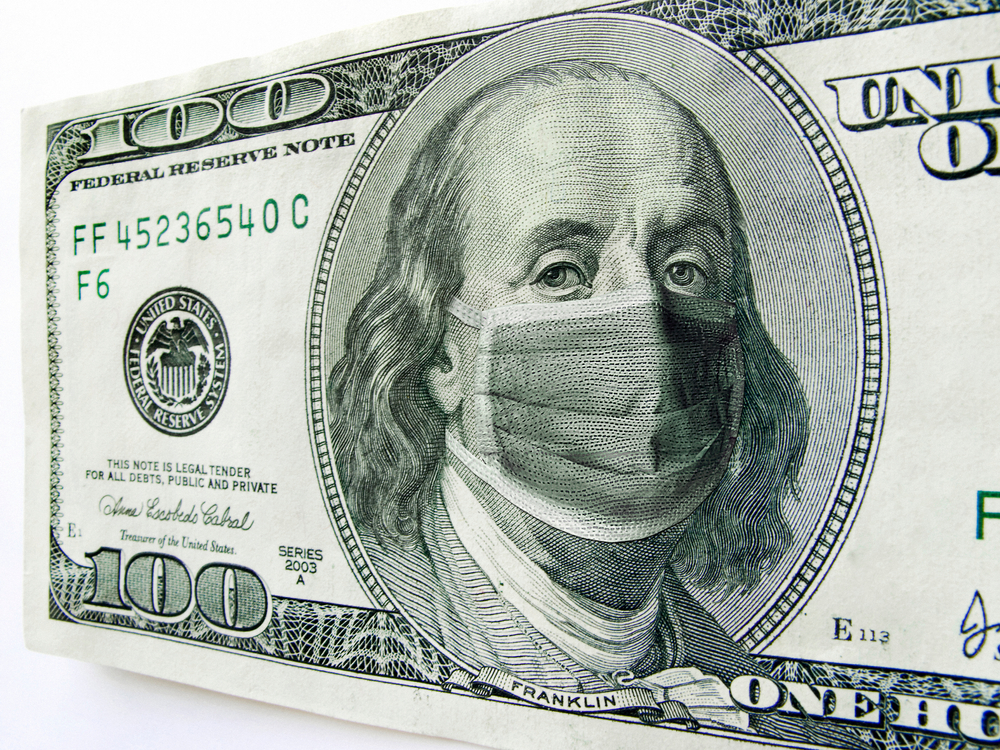
The Corona Economy: Will America Survive It?

New York City is losing billions in tax revenues, and Mayor Bill de Blasio is going to have to lay off thousands of city workers. He is upset about this. He’s calling on the Trump administration to bail out the city. “We can’t do anything about this,” he pleaded. (I’m paraphrasing.) “Only the federal government has the power to help us.”

Many in my family feel that we should keep the economy shut down “for as long as it takes.” They also say that the federal government should keep cranking out financial aid “for as long as it takes.”

“Human life is more important than money,” they say.

The trouble with mixing ethics and economics is not that they are incompatible. Quite the contrary, they are inextricably linked. The problem is that if you talk about them simultaneously, you never get anywhere.

Both subjects are important. Neither is dispositive or scientific. But economics has the advantage of a vocabulary of facts and a language of numbers. Thus, if you want to have the conversation about both, it’s better to start with the facts and numbers.

So let’s do that.

  • After crushing demand, the federal government’s $350 billion small-business relief fund ran out in less than two weeks. This week, the Small Business Administration began accepting new loan applications for an additional $310 billion in forgivable loans, with new rules in order to expand the initiative’s reach. (Though the agency’s electronic filing system crashed within minutes of the program reopening.)
  • The total “relief package” already enacted will cost about $2 trillion. There is good reason to believe that we will have a second and perhaps a third one at that same level.
  • We learned that 3.8 million more Americans lost their jobs last week – which means that the virus put around 30 million out of work within six weeks.
  • There are about 127 million households in America earning, on average, about $150,000. (That’s the mean, which counts the rich people. The median income is $60,000.) Ten million unemployed, multiplied by, say, $100,000, is $1 trillion. At an average tax rate of 20%, that’s $200 billion in lost federal tax revenues.
  • Tens of thousands of small businesses, representing hundreds of billions of dollars in tax revenues, have been shut down. Many of them will not reopen.
  • For some years now, the federal government has been running at a deficit of about $1 trillion a year.
  • Total U.S. debt is nearing $24 trillion and rising fast.

Would You Invest in This Company?

Think of the federal government as a business. I know that it’s not a business, nor is it intended to be. But hear me out.

You are an investor, trying to decide whether you want to buy this company.

The first thing you do is look at a spreadsheet of the financials – a P&L (profit and loss) statement and a balance sheet (assets minus liabilities).

You look first to the bottom line of the P&L, which tells you how profitable this company is. Hmm. Can that possibly be true? Is this company really losing $1 trillion a year?

Maybe it is investing for future growth, you tell yourself. Maybe, like Amazon in its early days, the Feds are spending money they don’t have in order to acquire income in the future. But when you look at the company’s projected income, it’s going the wrong way. Projected tax revenues are going down. Way down!

And what about its balance sheet? What about the company’s net worth? You glance at the liabilities and what do you see? You see $24 trillion in debt!

Surely, the company’s assets must offset this figure. You check that side of the ledger, and you see about $500 billion worth of gold (by today’s prices). Okay. You also see that the company has a great deal of valuable property (national forests and monuments and buildings and so on). But that property is encumbered. It can’t be sold.

From this perspective, the U.S. looks like a terrible business opportunity, right? It’s big-time broke and losing billions of dollars every day.

And thanks to the Corona Crisis, that debt and those losses are going to pile up faster than ever. The current bailout package is estimated to cost $2 trillion, bringing the projected loss for 2020 to $3 trillion. But to make matters worse, tax revenues are crashing. As I said above, it’s likely that they will drop this year.

Meanwhile, Mayor de Blasio is facing a fiscal crisis. Tax revenues are down more than $8 billion. And even with firing thousands of city employees, New York will still be short more than $6 billion by the end of this year… just to pay its upcoming bills.

That’s why he is complaining about Trump. He knows he doesn’t have a printing press to create money out of thin air. But the federal government does.

The federal government has the Treasury and the Federal Reserve. Since the dollar is no longer tied to gold or silver, its value is dependent on the trust of our big lenders (such as China and Saudi Arabia). If we keep printing fake money like we’ve been doing for so long, it’s possible that our lenders will stop buying our dollars. And if that happens, things will get a lot worse fast.

This is why some people are worried about the economy now. The federal government is in crazy debt and is losing money faster than it ever has before. Millions of people are out of work and tens of thousands of small businesses are dead in the water. That means a lot of pain and suffering. And the possibility of a deep depression like we haven’t seen in 100 years.

You may be thinking, as my brother-in-law said last night, that these facts and numbers must be false. After all, everyone knows that the U.S. is “the richest country in the world.” It can afford a shutdown of three to six months. You may be thinking, as some have said, that the economy will bounce back to full strength as soon as we get past this pandemic.

Maybe. But I doubt it. If I’m going to bet, and I probably will have to, I’m going to bet that things will get worse before they get better. You can see exactly what I’m planning on doing with my money right here.

Editor’s Note: If you’re worried like Mark about what’s to come, then you need to see this. It’s a way to guard your nest egg from what we’re calling “Corona Crash Aftershocks.” It’s the ideal move for anyone looking to protect and grow their portfolio in an unpredictable market. Click here for all the details.


How to Protect Yourself From the Next Worldwide Economic Collapse

Founder’s Note: This essay from Mark Ford exemplifies why I am so excited to bring him into the Manward fold. It hits at everything we’re so passionate about. He talks about the value of good ideas… he shows why the economy is so messed up… but best of all, he tells us what in the world to do about it. As the nation frets over the true fallout from the latest crisis… this is a must-read piece.


Making good investment decisions is both a science and an art.

You can, for example, track investment sectors, fund managers, and even investment advisers with precision. You can see their successes and failures. But past performance, as we all know, is no indication of what will take place in the future.

You can calculate with reasonable precision global money flow, government and personal debt, unemployment, the gross domestic product, and so on.

But these data won’t tell you with any certainty what and when some macroeconomic event might happen.

The problem is twofold. For one, the global economy is so damn big and complicated.

Secondly, humanity’s response to economic shifts is equally complex. And this is to say nothing of “black swans” – unpredictable events that cause major turmoil.

Seeing the future is impossible.

Still, as lowly investors, we must try. We must make regular buy, sell, and hold decisions. And we must make general judgments about the market to assess our holdings.

As you may know, I’ve been in the financial publishing business for more than 35 years. In that time, I’ve worked with many of the best investment writers and followed their advice. I’ve even been able to see unpublished analytics that track their performance.

I’ve concluded that most haven’t a clue about the future. But there are some who are actually very good at making specific investment recommendations – for a time.

There are also some who are good at big-picture economic analysis. By good, I mean they are able to write arguments that convince me, a skeptic.

Of those few who are good, about half are perennial optimists. The other half, of course, are perennial pessimists.

What I do is this…

Optimists and Pessimists

I read the best big-picture writers I know – not to “know” what the future holds, but to get a sense of what might happen. Then, I look to specialists for specific advice that would apply.

Around 2004, my favorite pessimists were predicting a collapse of the real estate market, the dollar, and the stock market. They predicted a serious economic recession as a result of the insanely overvalued real estate market and the government’s love affair with paper money.

The optimists were saying not to worry.

I found the pessimists – especially my colleague and business partner Bill Bonner – more convincing.

So what did I do?

I did not sell all my stocks. But I did sell off any stocks I felt might not recover from a major economic collapse.

I did not sell all my real estate. But I sold most of the real estate that wasn’t generating a rental income that would give me more than 5% returns even if rental prices dropped 25% or 30%.

And, for the first time, I started buying gold.

To keep things simple, I bought gold bullion coins. Over the course of two or three years, I bought gold every month until I had a tidy sum stashed away.

By tidy sum, I mean it was enough to support my family in the event of a sustained depression. But I did not bet the farm on gold prices rising because I had no certain knowledge of whether gold prices would go up or down.

My guess is that gold coins at that time came to represent about 5% of my wealth.

As it turned out, the pessimists were right. The economy went south, the stock market followed it, and the price of gold soared.

My stock portfolio went down but not terribly because I had nothing but what I call “legacy” stocks. I owned companies, like Coca-Cola and Nestlé, that I was pretty sure would do well even during a serious recession.

I didn’t sell those stocks, because I had a long-term view. Now, of course, I’m glad I didn’t sell.

And although the value of my real estate holdings went down, I kept making good income from the properties I kept.

Making these adjustments – reducing my exposure to risky assets, focusing on income, and buying gold as insurance against disaster – was about hoping for the best but preparing for the worst.

The collapse of the real estate bubble made millions of middle-class Americans poorer and thousands of bankers, brokers, and other members of the financial-industrial complex richer.

It amounted to a multitrillion-dollar transfer of wealth from Main Street to Wall Street.

In a truly free market, a financial recession has a positive effect. Like a forest fire, it kills off unhealthy businesses and financial practices and replaces them with better ones.

But the U.S. economy is not a genuinely free market. It is highly manipulated by large industries and businesses that persuade local, regional, and national government officials to pass laws beneficial to them.

On top of that, you have a political environment that compels politicians (Democrats and Republicans) to spend money we don’t have, jacking up the national debt.

All of which is to say that, despite what you sometimes hear from the financial media and bullish investors, the U.S. economy is very much in danger of another major, long-term financial collapse, possibly one much larger than the “Great Recession” we experienced in 2008.

It may already be happening. So what shall we do about it?

Shields Against Financial Disaster

Here’s what I always recommend:

First…

Make sure you have what I call a “start over again” (SOA) fund – a store of liquid wealth that can cover the costs of starting your financial life over again if all your intangible assets (stocks, bonds, and cash held in banks) disappear.

The amount of money you should have in an SOA fund depends on your situation. If you are an employee, make sure you have at least one year’s income. If you own a business, make sure you have enough to restart it or a similar business.

Your fund should consist of gold coins and cash stored in easy-to-access places.

If things really do implode, you don’t want to be calling a broker or banker asking them to cash in your accounts only to hear that the government has frozen such transactions.

Second…

If you can afford to buy rental real estate, do so. I’ve said this many times. Rental real estate is a great source of part-time income. It’s easy to understand. And as long as the price is right, it can be very lucrative.

If you can find a single-family three-bedroom, two-bath house for $144,000 that rents for $1,500-plus per month, buy it. Buy as much property as you can in the same neighborhood to make management easy.

If you can’t afford the down payment, you can find partners to work with you. This is something any smart person can do. You don’t need to have a lot of cash.

Third…

Review your stock portfolio to make sure that it is safely invested. This is not the time to be overly speculative. Try to buy only big, cash-flowing businesses sure to weather any “black swan” event in the markets. I suggest you stick to the sorts of stocks I invest in (mostly the world’s most stable, blue-chip, dividend-paying companies).

Investing this way will ensure that your equity holdings survive a large-scale, long-term financial collapse. And if there is a collapse, the decreased stock price of these companies will present a great opportunity to pick up more shares on the cheap.

Finally…

Consider becoming an “international” person. By that I mean having an offshore residence, business, bank account, and passport or residency permit.

This may seem like a very exotic option, but it’s easier and cheaper than you might think. You could, for example, have all three of these things in Nicaragua or Panama for less than $150,000.

Looking offshore gives you several benefits: a safe haven to retreat to if living in the U.S. becomes dangerous, ways to earn extra income with big tax advantages, and a lower cost of living.

My Six Secrets to a Six-Figure Income

Founder’s Note: I’m so excited to bring you this note from Mark Ford… the newest (and perhaps most iconic) member of our team. In my mind, it is the perfect essay for Manward. It reveals the truth about how to get rich – the truth nobody else wants to talk about. Enjoy it… and let me know your thoughts.


I’ve been writing about creating wealth for a dozen years. Before then, I wasn’t writing about it. I was doing it.

My income has actually increased since I stopped actively “creating wealth.” But that’s the thing about getting rich – when you get rich it is just too damn easy to get richer.

It’s not fair, but it’s a fact.

When I decided to get rich, I didn’t know the first thing about the subject. I was an editor. I wanted to be a novelist. I had never taken a course in finance or economics. Plus, I was broke.

But I had a great advantage. I was working for a human wealth machine – a man who, at 43, had already created three hugely profitable businesses. He decided to adopt me as his surrogate son and taught me everything he knew.

I retired 12 years later with a net worth well in excess of $10 million.

Two years later I went to work as a business consultant to Agora. Bill Bonner, Agora’s founder, adopted me as his kid brother. He also taught me everything he knew. In the 15 years that have passed since then, my wealth has multiplied many times over.

Starting at age 50, I wrote about entrepreneurship (under my pen name Michael Masterson) for 10 years. I wrote about close to a dozen books and several thousand essays. I adopted my readers as my surrogate siblings. I told them everything I knew about starting businesses.

Then, at 60, I retired the Michael Masterson pen name. Since then I’ve attempted to tell my readers everything I know about creating wealth – which is a bigger and more complicated subject than entrepreneurship.

Today, I want to briefly introduce you to six basic truths about wealth building that have made me successful.

Some of the secrets you won’t learn anywhere else. I haven’t seen them written in the mainstream financial press. And many of them were learned the hard way – by me.

First, let’s begin with some of the lies about creating wealth. At one time or another in my wealth-building career, I foolishly believed in the following so called “facts”:

  • Wealthy people are stingy for a reason. The secret to becoming wealthy is to scrimp and save.
  • The stock market is the most efficient way to invest. You can’t become wealthy unless you understand and master the stock market.
  • Geopolitics determines investment outcomes. You can’t become wealthy unless you understand politics and economics.
  • The general public is always wrong about economic and financial trends. The fastest way to acquire wealth is to invest as a contrarian – i.e., against market sentiment.
  • Economics is governed by the inverse relationship between risk and reward. If you are not willing to take big risk, you will never enjoy big profits.

Do any of these “truths” sound familiar? Have you been following any gurus that advocate these “facts”?

If so, pay attention. I’m not the only person in the world that went from broke to rich. There are many, many people that have done so and some of these people have written books about it.

I don’t read all the popular books on wealth building because I feel comfortable with the system I’ve developed myself, through my own experience. I don’t follow the advice of others except when it dovetails with my own experience.

But that’s not to say that my system is the only system that works. Nor do I want to argue that it is the right system for you. All I can do is report my own experiences to you as honestly as I possibly can.

You are my surrogate siblings. I want you to succeed. The only way I can help you is to tell you what I know to be true. And this is what I know – from my own experience – to be true about creating wealth:

Truth #1

You’ll never get rich unless you understand some fundamentals about saving, spending and investing.

Truth #2

The single most important factor in avoiding the spending spiral that kills wealth is to stay in the house you have now. Nobody else that I know of has made this simple point. But I can tell you that it is true.

Truth #3

Stock investing (or even stock and bond investing) are inadequate strategies for building wealth. They won’t get you rich or make you wealthy however much you wish they would.

Even Warren Buffett, the world’s most successful investor, knows this. His wealth has come not from being an individual investor but from being the principal of Berkshire Hathaway – a business. Keep that thought in mind every time you hear his name quoted.

Truth #4

The most important single factor in wealth building is the size of your investible income. Investible income is what you have left over each month after you’ve taken care of your lifestyle expenses.

Again, nobody else I ever read had the courage to say this before I did. (Now I see one of my protégés saying this and of course I am flattered to hear him pretending it is his own idea.)

Actually, that’s the second most important factor in building wealth. The No. 1 strategy is acquiring equity in a startup business. There are many ways to do this. The most commonly talked-about ways are downright foolish. But there are smart ways to do this even if you are a novice to business.

Truth #5

Investing in rental real estate is unique – it stands halfway between active income and passive income. Next to entrepreneurship, it provides the highest return you can get from any financial endeavor.

Truth #6

The biggest mistake retirees make is giving up their active income. I know that this is exactly what you hope to do some day. But I’m warning you. It’s a big mistake.

If you are already retired, you are probably hoping you can replace that income with passive investment strategies. I’m here to tell you that they won’t do.

To keep your wealth for a lifetime you need multiple streams of passive income. Your goal should be to build each stream of income to a level that you can live on that and that alone.

In the coming weeks, I’m going to continue sharing my wealth-building secrets with you. I’ve been so fortunate to have had mentors who have helped me, and I hope my success will inspire and motivate you to take steps to building your own wealth and living rich.

BROUGHT TO YOU BY MANWARD PRESS