Buy This, Not That: Wall Street’s Backward AI Trade
Shah Gilani|December 10, 2025

Wall Street has this one completely backward.
Two stocks are racing to build OpenAI’s $400 billion Stargate data center project. Both have been hammered lately.
But here’s what’s fascinating…
The “hot” one everyone’s excited about? It has $4.3 billion in revenue and loses 17.8% on every dollar.
The boring one Wall Street crushed? It has $59 billion in revenue and prints 21% profit margins.
One has a debt-to-equity ratio of 485%. The other sits at 452%.
Yet guess which one is trading like a darling… and which one got demolished 45% from its high?
In today’s Buy This, Not That, I reveal why this gap won’t last – and which AI infrastructure play makes sense at these beaten-down prices.
Click on the image below to see which stock is a buy.
Transcript
Hey, everybody. Shah Gilani here with your weekly BTNT, as in Buy This, Not That.
Today, I’m going to pit Oracle (ORCL) against CoreWeave (CRWV). Why? Well, for one reason, Oracle’s got earnings coming out today. By the time you get this, it’s going to be very interesting because the stock has been beaten up. It’s down 45% from the gigantic move it made.
Meanwhile, CoreWeave, which had a great move up, has been hammered on the way down, too.
So why am I comparing Oracle to CoreWeave? Because both of them are tied to OpenAI. They’re both part of this Stargate buildout of these massive data centers. And CoreWeave is doing it for OpenAI, and Oracle is building out for OpenAI. Oracle is going to have to borrow something like $400 billion. CoreWeave – not quite sure how much they’re going to have to borrow – but they’re in the same game.
I think Oracle has a much better leg up. So let’s take a look at the charts, and we’ll compare them both visually as I give you some numbers. First up is CoreWeave. Looking at CoreWeave here, this is the chart of CoreWeave.
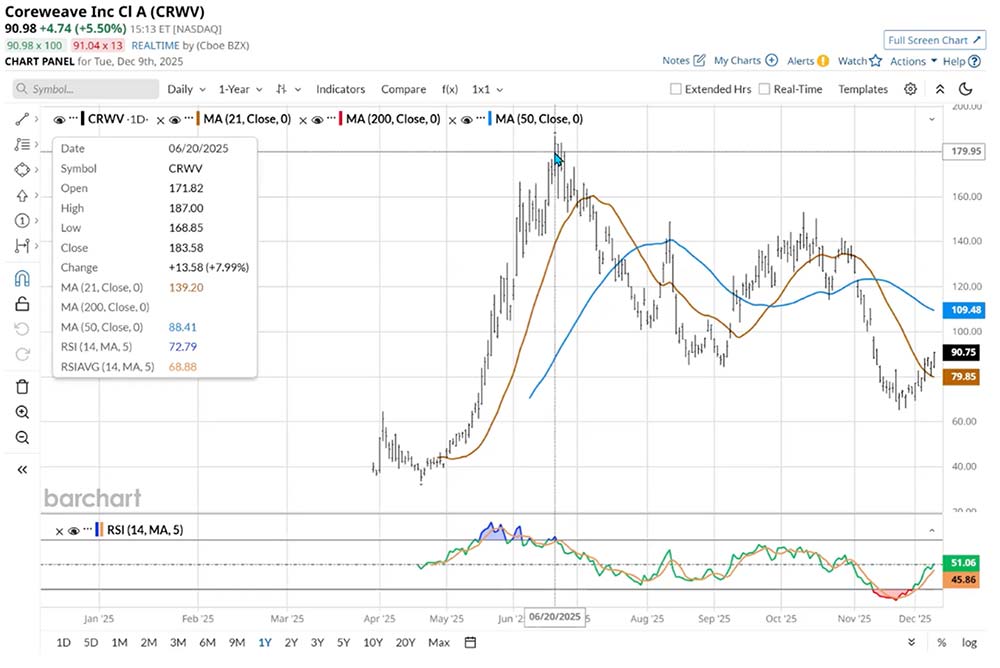
You can see this tremendous ride it had up here. We’re talking about in June, CoreWeave got up to an intraday high of $187. We’re down at $90. So it’s been cut in half and more than that.
But we had a little bounce up and then got knocked back down. Now it looks like the stock has hopefully bottomed out if you own CoreWeave. But again, CoreWeave – we’re not talking about huge revenue. Here we’ll call it a $43 billion market cap company stock with approximately $4.31 billion in revenue. That’s tiny compared to Oracle’s.
Oracle’s revenue, people, is $59 billion. So you’ve got $4.31 billion for CoreWeave, $59 billion-plus for Oracle. Now, profit margin-wise, it’s negative at CoreWeave. Negative 17.8%. Well, of course, Oracle, having been around a lot longer, is profitable.
Profit margin there is 21%. And yes, they make a lot of money. But CoreWeave has become this darling. It’s like it’s going to be building out cloud space, and everybody knows data centers and the cloud space for data centers and the whole AI thing.
And again, this is tied to OpenAI. So CoreWeave is tied to OpenAI. And that’s given it a lot of clout. But really, people, the numbers aren’t very compelling.
Oracle, on the other hand – guess what? Absolutely compelling up to the point where you start to look at, wait a second, how much money are they going to have to spend to appease OpenAI? $400 billion at the last count. Well, here’s what happened when they talked about how huge their backlog was going to be.
How about $400 billion? But that $400 billion backlog, which caused the stock to pop, people – an intraday high of $185 up here.
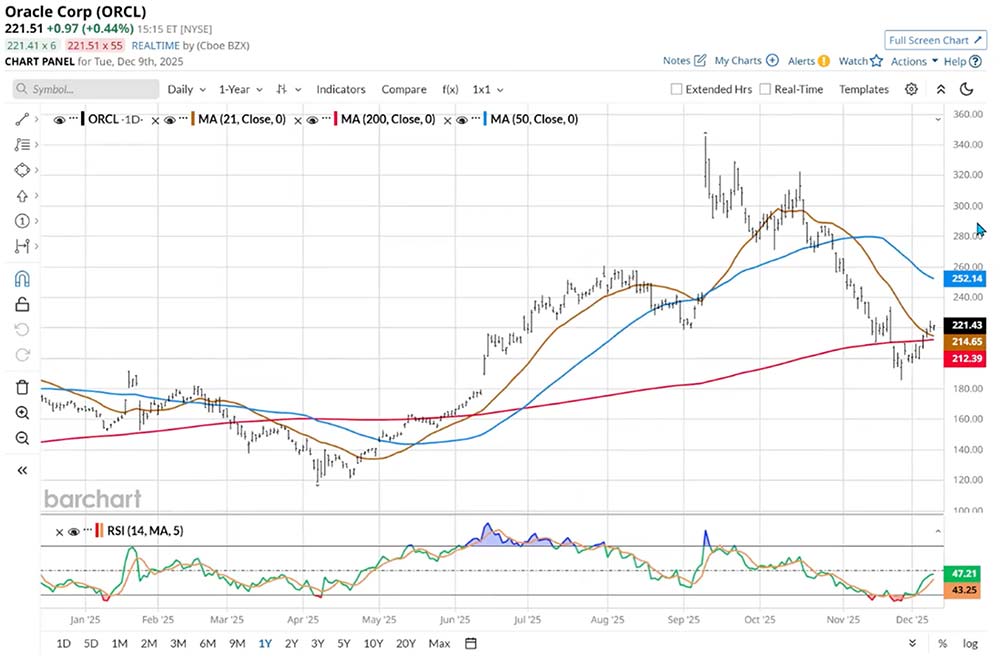
This is the intraday high the following day. This is the 10th, and we’re talking about an intraday high of $345. The day before, on the 9th, it closed at $241. So from $241, you have this gigantic gap up to a high of $345, but it closed at $328.
Now that pop made Larry Ellison, for about a day, maybe a little longer, the richest man on the planet. Now the stock has come right back down to fill this gap. As I talk a lot about, gaps fill this gap. That’s not a bad thing.
Now, hopefully it’s bottomed out and moved up here. Yeah, that’s positive. Now, earnings are coming out Wednesday for Oracle. It’s going to be a big deal.
If Oracle doesn’t lean into how much capex they have to go through and spend and how long it’s going to take to recoup that, then their earnings might be good. And if the earnings are good and – I’m going to call it whatever the takeaway is from the call in terms of monetizing the buildout that they’re going to spend $400 billion-plus on – the stock might pop. There isn’t a huge short position in Oracle. But again, this is a company that’s profitable, people.
And I like the stock down here. I think it’s a good spot to buy. Certainly for me, if Oracle gets beaten up on earnings, I would definitely buy it somewhere down here. If I could buy Oracle at $185 or below, maybe $165 to $185, I’m definitely going to buy it for the long term.
Now, Oracle versus CoreWeave.
I’m going to go – again, here’s CoreWeave, and here’s the CoreWeave stock.

Now, yes, they’re both tied to OpenAI in a big way. But Oracle’s got a lot more going on. Oracle has a lot of enterprise customers that can actually use the AI that is going to partner with OpenAI, that Oracle’s going to partner with OpenAI to build out their extension of the data centers and the Stargate, which again, CoreWeave is part of also.
But I think it’s going to be a lot easier, even though the debt is huge, for Oracle to monetize what it’s doing with OpenAI than it is for CoreWeave to monetize all their spend. Oh, by the way, the last thing I’ll say is debt-to-equity ratio. CoreWeave doesn’t have it easy, people. Everybody points to what Oracle’s debt-to-equity ratio is.
Debt-to-equity is 452% at Oracle. People, it’s 485% at CoreWeave. So when it comes to CoreWeave versus Oracle – to me, as scary as it is, and it’s even more scary because traders are bidding up the credit default swaps on Oracle debt.
That’s not a positive sign. That’s a worry sign. I still will buy and prefer Oracle over CoreWeave. So when it comes to BTNT, buy Oracle, not CoreWeave down here.
Cheers, everybody.
Shah Gilani
Shah Gilani is the Chief Investment Strategist of Manward Press. Shah is a sought-after market commentator… a former hedge fund manager… and a veteran of the Chicago Board of Options Exchange. He ran the futures and options division at the largest retail bank in Britain… and called the implosion of U.S. financial markets (AND the mega bull run that followed). Now at the helm of Manward, Shah is focused tightly on one goal: To do his part to make subscribers wealthier, happier and more free.