Biden Gives Banks Their Money Back

Why don’t more folks invest in banks?

They should. The average bank has seen its shares rise 25% this year.

The S&P 500, though, is up just 6%.

Banks are clearly the better play.

The reason the financial press doesn’t give the sector much airtime is it’s boring… and might even hold a few secrets the folks at the top don’t want you to know about.

Unlike Tesla (TSLA) and the crazy tweeter behind it… or Disney (DIS), the mother company behind much of the media world… banks don’t have a new and sexy product. They’re not dealing with cutting-edge technology or booming consumer trends.

Or are they?

As usual… some Manward-style facts may open a few eyes…

From Gutenberg to Powell

The way we see things, banks are the greatest beneficiaries of history’s top technological innovation… the printing press.

As you know, President Biden signed off on another major stimulus bill last week. A whopping $1.9 trillion will flow like molasses from a spilled tanker.

Rivers of wealth will flow in every direction.

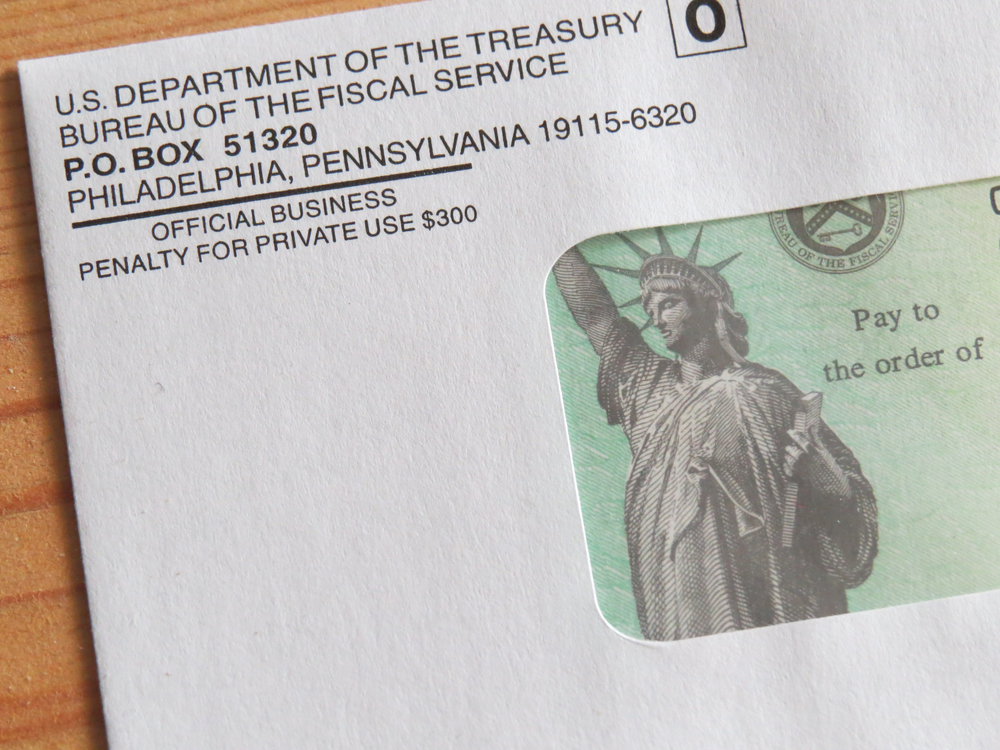
Consumers (aka voters) will get covered in the sweet nectar first. We’re told some folks already have their money.

That means – through the magic of modern finance – the money is already in the hands of the big banks.

Again, thanks to modern technology, the move is quick these days. Nothing really gets printed. Somebody in D.C. just taps a 13-digit number (there are a lot of zeroes in a trillion bucks) into a computer… and, bam, money in the bank.

The folks behind the free-money free-for-most say the money will go straight toward stimulating the economy. In a roundabout way, they’re half right.

First, it will stimulate the banks.

Paying Back the Banks

Perhaps this is a good time to remind you that the nation’s banks have 439 lobbyists hiding in Washington’s swampy reeds. Some 70% of them used to work directly for the government.

The $60 million that their employers gave directly to campaigns last year was surely still on the minds of the newly elected lawmakers crafting last week’s big bill.

Congress knows how to spin a gift for one into a perceived gift to many.

And while your neighbor may be thrilled to see an extra $1,400 in his bank account… the bank is likely a whole lot happier to see it.

That’s because the vast majority of that money will stay in the banking system.

A recent survey spilled the beans…

Thirty percent of folks said they’ll use their free money to immediately pay off debt.

Another 25% said they’ll save it.

Nine percent said they’ll invest it.

Only the remaining 31% said they’ll push the cash out of the banking sector by spending it.

But even that’s not bad news for the banks. Thanks, again, to today’s modern digital money, most of that money will flow right through a bank’s digital processing system… collecting a toll along the way.

Ruffling through the industry’s books, we see just how profitable all this is.

Bottom-Line Boost

The biggest of the big numbers are on the banks’ balance sheets. That’s where, about this time last year, bank executives were writing off “bad” debt at a scary pace.

All told, the nation’s top lenders had $118 billion set aside to cover loan losses at the end of last year.

Now that several rounds of stimulus have covered the bare butts of so many debtors, banks are slashing their reserves.

Just last quarter, JPMorgan Chase (JPM) cut its bad-debt funds by $2.7 billion.

Citigroup (C) has pulled a billion out of reserves.

And, way over there across the pond, Barclays (BCS) just said the $684 million impairment charge it put in its books was far less than the $957 million charge it had penciled in months earlier.

Better yet, it said future write-offs will be “materially below” what it saw last quarter.

For banks and their shareholders… this is the equivalent of free money. It flows directly from the balance sheet to the bottom line of the income statement.

From here, the numbers will only get better.

It’s a great time to be a bank… and an even better time to own their shares.

Here’s Where to Stick Your $1,400 “Stimulus” Check

Golly… is it any surprise that the same day as Washington passed the $1.9 trillion stimulus bill, Warren Buffett’s wealth odometer finally rolled over the $100 billion mark?

Is it any surprise that at the same time as the sixth round of stimulus in 12 months hit the president’s desk, the Dow notched another record high?

And, oh my, should we be surprised that the nearsighted folks in D.C. are running victory laps as they say the $3,700 in net benefits the average American will see from this deal will cut the nation’s poverty rate by a third… well, at least for this month?

Let’s be clear… Self-reliance must be the goal of every person on this planet.

An economy that depends on monthly payments to parents… debt forgiveness… and handouts just for helping to jump on the chest of a dying marketplace is not healthy.

And the very best way to ensure you don’t succumb to this 21st-century version of national debt-fueled indentured servitude?

Follow Mr. Buffett.

The Rich Get Richer… and So Can You

We’ve written about it before. It’s the greatest form of stock market alchemy in history.

Once opposed to it, Buffett has seen the light and the dollar signs.

Let us show you a moneymaking chart…
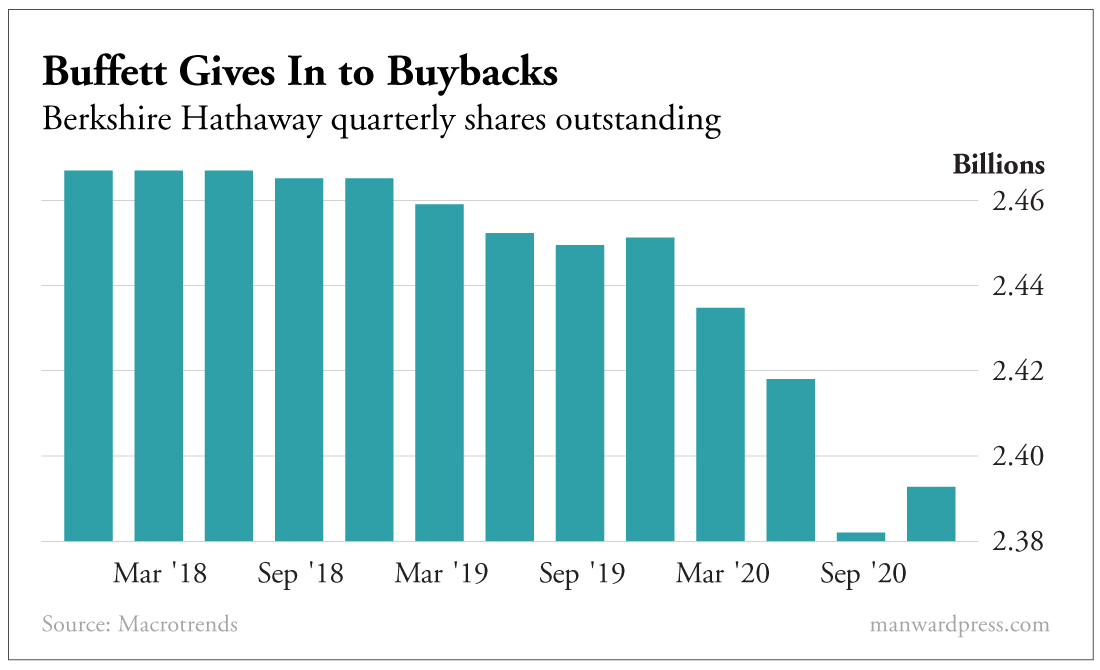
Buffet Gives in to Buybacks

The chart shows the number of outstanding shares of Berkshire Hathaway (BRK) – Buffett’s oh-so-deep honey hole.

For years, the number of shares on the Street hardly budged. Then again, the same was true of its share price. Berkshire has infamously underperformed the S&P for the last five years.

The rise of the S&P, of course, has been driven largely by share buybacks. We’ve cited the evidence numerous times in this column. It’s no surprise that if Buffett wasn’t buying back, he wasn’t keeping up.

But he finally gave in last year.

He ordered his firm to spend a record $24.7 billion of its cash buying back its own shares.

The stock finally started to move.

The trend has continued into this year. Some $4.2 billion worth of Berkshire’s corporate cash went to buybacks in just the first six weeks of the year.

Shares are up 15% year to date – firmly beating the market’s 3% climb.

Is Buffett’s big win a sign that the economy is any stronger than it was a year ago?

Is it proof that he remains the ultimate stock picker?

Or is he simply doing what so many other rich guys are doing… and taking full advantage of all the free money that’s floating around these days?

You know the answer.

Buy Now

Again, it is no coincidence that at the very same time as Congress put its stamp on a $1.9 trillion stimulus bill, news outlets report the world’s wealthiest have seen their net worth rise by $1.8 trillion.

It’s funny how that works.

But here’s the good news.

Buffett… Bezos… Zuckerberg and the like are not doing anything you can’t do. They don’t have access to a different money-printing machine.

Nope. They’ve tapped into the same one all of us can – and must – tap into.

They own stocks… lots of them.

There is no doubt. The Dow is going to 100K faster than most folks think possible.

All that mailbox money that’s about to get shipped out will not stay in the hands of its recipients for long. Just as Congress intends, it will go straight into the pockets of the nation’s biggest companies.

We’re crazy if we don’t own them.

If you get a check, use it to buy stocks.

It’s the simplest, most obvious trade in modern history.

Did you start investing – or start investing more – in the past year? Let us know at mailbag@manwardpress.com.

Bitcoin vs. Stocks: What the Charts Say

Something is stirring in the markets.

Interest rates are surging. The repo market – which serves as the backbone of the banking industry – is getting shaky. And in Japan, the publicly traded shares of its central bank mysteriously soared higher last week… before crashing.

In Japan, investors are thinking the odd action is in anticipation of news out of a big policy meeting on March 19.

In the United States, investors are praying the Fed does something bold during its own meeting on March 17.

Clearly the world of money is getting anxious. It needs its addiction fed.

The Doge Joke

Meanwhile, billionaires are having a bit of fun with it all.

“It’s just money,” they say. “They’re printing more of it all the time.”

Mark Cuban – the outspoken owner of the Dallas Mavericks and future presidential candidate – announced last week that his team will now accept Dogecoin (DOGE) as form of payment for game tickets and merchandise.

The same fella who told GameStop (NYSE: GME) gamblers to hold “if you can afford to” is opening the doors to a joke cryptocurrency largely because, well, it’s all fake anyway.

“Sometimes in business you have to do things that are fun,” Cuban said. “Because we can, we have chosen to do so.”

That says something about all of this.

It says a lot about all the monetary manipulation and its effect on the markets, your retirement and your way of living.

“Keep holding if you can afford to,” the folks at the top say. “If not, well, thanks for the chuckle.”

Warren Buffett shared his thoughts on the situation in his latest letter to shareholders.

That’s where he wrote, “Retirees face a bleak future.”

He blamed, of course, the same thing we blame. He says it’s record-low interest rates – particularly the fact that bond yields are negative when we dare to factor in inflation – that make it nearly impossible for folks to build up a retirement that doesn’t rely on government handouts.

Take risk… is the message from the puppeteers. Or else go broke.

Painting the Picture

But when we look at the latest charts, we can’t help but wonder whether the risks we think are risky… are risky enough.

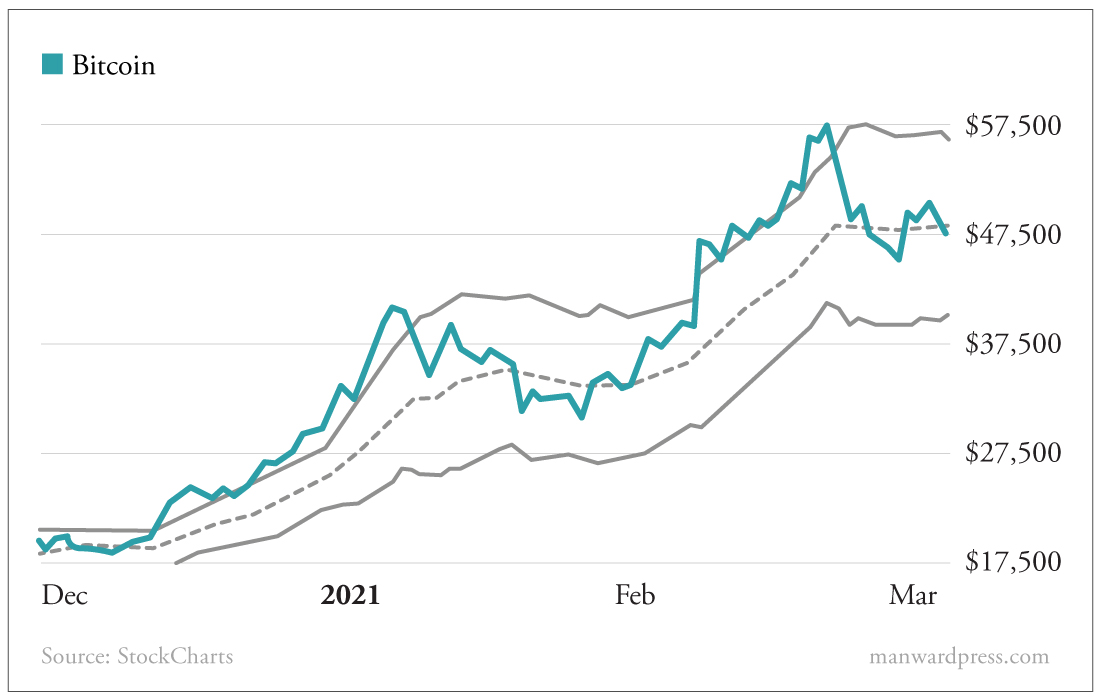
Right now, for example, Bitcoin’s chart looks a whole lot more appealing than what we’re seeing from the oh-so-mighty S&P 500.

The former is staying between the lines…
Bitcoin Chart
The latter is not…
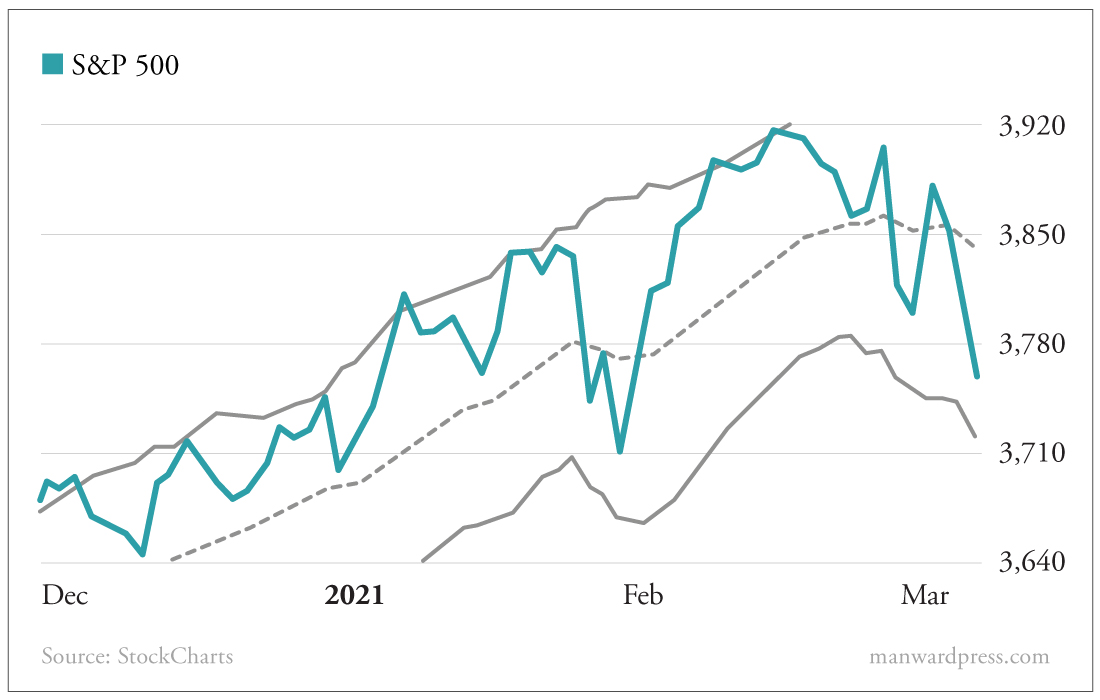
Chart S&P 500
Using the charting criteria we use in our popular Codebreaker Profits research service, high-risk Bitcoin is clearly the stronger asset.

Through the end of last week, it has steadily maintained its status as a bullish momentum play. The line on the chart that represents its mid-channel average has proven to be a long-term level of support.

That’s not the case for the broad stock market, though.

It performed beautifully through much of the winter… while interest rates hardly budged. But now that rates are rising, its mid-channel support appears to have turned to resistance.

It’s not a good sign.

The week ahead will tell the tale. If the S&P can climb back above that dotted line, our risks in the stock market will continue to reward us.

If not – if rising rates continue to sink stocks – Mr. Buffett will be proven right. And Mr. Cuban will be laughing all the way to the bank.

Create a Different Future

The facts these days are clear.

Bonds will cost you money.

Stocks won’t climb without more intervention.

And digital gold is screaming, “Look at me!”

We say the best solution is to change the way you allocate your wealth. The old way of doing things clearly won’t work. It’s why we created our Modern Asset Portfolio – the model portfolio at the center of Manward Letter. It tosses away the worn-out rules of yesterday and focuses squarely on what’s really moving markets.

Right now, it’s begging us to buy assets that outperform when inflation is high and interest rates are low – that’s buyback stocks, tech disruptors and, of course, crypto.

Buffett is right. Retirement looks bleak for many.

But it doesn’t have to be.

Think and invest differently.

P.S. Late last year we released an in-depth presentation about the Federal Reserve’s big meeting on March 17. It’s now just days away. Which means it’s now or never if you want to get ahead of this news. Get all the details here.

Have you been loading up on the types of stocks Andy has been recommending? Tell us about it at mailbag@manwardpress.com.

The Problems (and Opportunities) With “White Gold”

We’re gearing up for a big boom in commodity prices.

We’ve already written you about the upshot in rising grain and ultimately food prices. That’s the simple stuff.

Things get a bit more complicated – and far more controversial – when we start looking at the side effects of the so-called “green revolution.”

Just this week, the chairman of Rio Tinto (RIO) quit his job thanks to the scandal over the mega-miner’s destruction of an indigenous site in Australia.

The ornate cave system lasted 46,000 years… but ultimately got blown up in the search for $96 million worth of iron ore.

Interestingly, at nearly the same time as top executives are running for the door, the company announced it’s now working to create a sustainable aluminum can. They’ll be smelted using “renewable” hydropower.

Not only that, but the company has taken it upon itself to launch a sort of “nutritional label” for its aluminum.

Using blockchain technology (huzzah!), Rio will send customers a digital sustainability label that details things like the amount of water used, energy sources, community investment, carbon footprint… and, we can only guess, how many artifacts were blown up.

It’s good news.

But fair warning… It comes at a cost.

Not in My Flowerbed

Meanwhile… the folks at Bloomberg are making life tough for an Australian firm that many think is committing similar crimes against humanity here in the States.

A rare form of buckwheat has been “dug up and destroyed,” the news rag said.

That plant, it turns out, has been a thorn in the side of the company that wants to level the land and start digging for lithium… or “white gold,” as many are calling it these days.

Lithium, you may know, is a huge player in the electric vehicle game.

The average battery-powered car has more than 20 pounds of the stuff in it. The world needs a whole lot more of it.

“You can’t have green energy without mining,” said Mark Senti, the CEO of rare earth magnet company Advanced Magnet Lab. “That’s just the reality.”

“Ehhh,” says the Prius driver. “We never thought of that.”

Meanwhile, the mystery grows in the Nevada desert.

The detectives at the U.S. Fish and Wildlife Service blame thirsty squirrels for the destroyed buckwheat.

The anti-mining Center for Biological Diversity says no way. It argues that where there are squirrels, there is poop… and there is no poop.

The glove doesn’t fit.

It blames the mine.

Either way… the cost of mining lithium in the Nevada desert just went up.

Elon Musk can’t be happy.

Moving South

Meanwhile… as we’re wont to say, money goes where money is treated best.

Down in the Andes, folks aren’t quite as worried about where the deer and the antelope play. Or, to be clear, the folks who do care don’t have the money to care enough.

Bolivia has some of the world’s largest concentrations of lithium. And with a GDP that’s roughly a third of Rio Tinto’s market cap, well, let’s just say its people have already eaten all the buckwheat in the fields.

The government there has done a bang-up job to corrupt and screw up its nascent lithium boom. After seeing the country jump in and out of billion-dollar deals, now folks from China and Germany are knocking at the door.

They’re desperate to get their hands on the metal. China, don’t forget, will need some 800,000 tons of lithium by 2025. And if it wants cheap product, it knows it has to go to a place where endangered plants naturally find a way of disappearing.

A boom in the country may finally sound like good economic news for the poor folks of Bolivia. But it’s not. The nation’s law says only the state can mine lithium.

The private sector is cut out.

It’s good news for whoever has taken power this week… and better news for Elon Musk.

After the country held its own “rigged election” that many called a “lithium putsch,” the Tesla founder was accused of pushing the former leader – and fan of privatization – out of office.

Musk infamously tweeted, “We coup whoever we want! Deal with it.”

Golly… we hope there’s none of that in our Green New Deal.

It turns out that getting cheap lithium is actually quite expensive.

A Lousy Deal

But this stuff isn’t happening just in rocky Bolivia. Farther south in Chile, money is also flooding to where it’s treated best.

A 2016 article by The Washington Post proves our point. It detailed how a joint-venture lithium miner named Minera Exar made a deal with half a dozen indigenous groups to launch a new mine.

The mine had an expected payout of $250 million per year. Each tribe, meanwhile, is happy to get a check for somewhere between $9,000 and $60,000.

Across the mountains in Argentina, hopes are high. Optimists say the country could supply all the world’s lithium by the end of the decade. Realists say the dead-broke government will screw it up once again.

Even if hope wins out and the government doesn’t use the profits to pay off its debt, it’s trouble for the locals who already don’t have enough water. Lithium extraction requires 2 million liters of water per ton of mineral.

There’s not enough to go around.

Again… somebody has to pay for the falling price of lithium batteries.

The Solution?

Before the haters go and think we’re against the green movement… don’t bother writing.

We own a flower farm, for Pete’s sake. We practice regenerative grazing. We held a newborn sheep in our arms at midnight last night. We nurture our forests. And we’re at the starting gates of a major, multiyear stream restoration.

We’re as green as it gets.

But above all, we seek the full truth, not the headline truth.

Driving a car powered by a battery may get the oil smell of your clothes… but it puts a mine in some poor soul’s backyard.

And if it doesn’t, the only other option is for prices to rise significantly.

We’re convinced this push toward new forms of energy will spark a great and long-lasting increase in commodity prices that few folks in power are clear-headed enough to see.

As fans of the free market, we’re putting the idea to work.

On Tuesday, we told our Manward Letter readers to prepare for the start of a fresh commodities supercycle by grabbing shares of a company that gets paid to move all these high-demand commodities from one place to another.

And last week, we told our Codebreaker Profits subscribers about a very bullish technical setup for a little-known company that’s working to boost lithium efficiency… not pull more of it out of the ground.

The truth is never as pretty as the headlines want you to believe.

We’re good with that.

There’s big profit potential in sorting the right from the wrong.

The truth is… if this world is as green as it says it is, prices are going up.

Like what you’re reading? Send your thoughts to mailbag@manwardpress.com.

How to Know When the Fed’s Free-Money Trade Is Over

Is the COVID trade over?

Not according to the folks in charge of the nation’s money.

And this time… we agree.

The president of the Kansas City branch of the Federal Reserve, Esther George, told us this week not to worry about rising interest rates.

“I don’t know that, based on the levels that we’ve seen so far, that [rise] poses any challenge to the Federal Reserve’s monetary policy,” she said.

“I don’t think the rise we’ve seen is concerning to me at this point, but we’ll keep watching it to see whether we’re getting other signals about tightening financial conditions.”

The Fed, of course, doesn’t want rates to rise nor does it want “financial conditions” to tighten.

The nation’s fate depends on truckloads of free money and loose policy to pull it out of the trap it’s waltzed into.

Rising Rates

As the rate on the 10-year Treasury climbed above 1.3% this week, Uncle Sam’s debt is officially trading at pre-pandemic levels.

The flight to safety that had investors rushing in to bid up the price of Treasurys and push down their interest rate has waned.

Wednesday, for instance, was a key day in the nation’s debt market. That’s when the Treasury auctioned off some $27 billion worth of 20-year bonds.

Demand was lousy.

The bid-to-cover ratio, which measures the dollars bid for every dollar of debt offered, dropped to a record low of 2.15.

One line from a Jefferies analyst sums it up…

“The 20-year point is really struggling without the support of the [Federal Reserve’s] purchases…”

And so it goes… The market tries to do what a healthy market must do… and the Fed dives in to mangle it all up again.

Jay Powell is set to give a speech next week.

He’ll likely have a checkbook hanging out of his pocket as he promises to swoop in to buy more debt and push rates lower again.

The last time rates rose, you may recall, Americans lost a lot of money.

Powell’s not ready for it to happen again.

Better Numbers

But really, it’s not the Treasury market us oh-so-ordinary investors must watch.

To see where this mess is headed, there are two other key rates we need to keep an eye on.

The first, of course, is what’s dubbed the “real rate.” That’s the Treasury rate minus the rate of inflation.

When we look at that number, we see just what it is the market is working to adjust for… rising prices.

Subtracting the current rate of inflation from the 10-year Treasury, we get a figure of negative 0.92… the same ultra-low level we were at a month ago.

The near-record-low figure gives us a clue that the market is not necessarily pricing in a stronger economic rebound… but is more focused on rising inflation.

A $2 trillion stimulus bill… plus whispers of all sorts of new (and expensive) programs will do that.

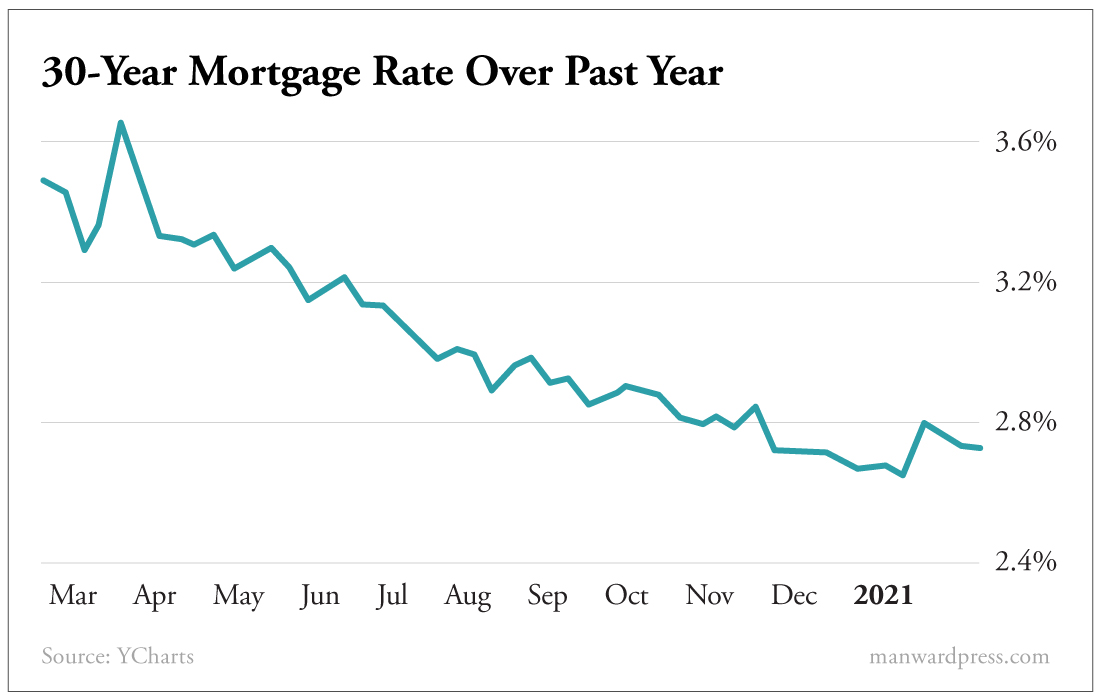
The other key number to watch is mortgage rates.

There’s good news on that front. They have not yet tracked Treasury rates higher. They’ve been flat for two weeks straight.

30-Year Motgage Rate

Again, it’s a sign that most folks believe the recent rate climbs are not the start of a long-term trend.

If either of these rates begins to climb appreciably, then it’s time to pay attention.

For now, our Modern Asset Portfolio remains solidly in its “negative real rates” category. That means we overweight our holdings to buyback stocks, tech leaders and cryptocurrencies.

As you likely know… it’s paying off handsomely.

Our crypto play in Manward Letter rose to another fresh high yesterday… a gain of 187% since October.

We’ll watch Powell and the 10-year. But we have a feeling his friends at the Fed are about to get out their checkbooks, start another bond-buying frenzy and push yields lower again.

Watch for it next week.

It will prove the free-money trade that the COVID crisis kicked off is far from over.

Be well,

Andy

How have low interest rates affected your savings and investments? Tell us about it at mailbag@manwardpress.com.

How Long Will This Bull Run Last? Here’s the Answer

Stocks are at record highs.

Cryptocurrencies are soaring.

Commodities are pedal to the metal…

And Washington wants to hand you even more free money.

Our mantra continues. It’s a great time to be an investor.

Oh boy… is it.

Buy Crypto!

We’ve focused our efforts on crypto in recent weeks. As we said in our recent research, crypto is set to, once again, far outpace the gains from stocks over the next 12 months.

At this point, it’s going to be tough for stocks to catch up.

So far this year, Bitcoin is up by more than 55%.

Just last week, in our Alpha Money Flow research service, we sold our first two crypto plays. One was good for a 40% gain overnight… the other was a 63% win in 56 days.

But let’s be 100% clear…

What’s happening with these coins has very little to do with the future of money or some big breakthrough in crypto technology.

What’s happening is exactly what we said would happen.

Our Dow 100K thesis says this race to the top will continue to gain exponential speed as stocks and all things liquid soar to unthinkable highs.

The idea hinges on the fact that oodles and oodles (the most precise term in times like these) of cheap or even free money is spreading throughout the economy. With no firm foundation to build on (GDP growth still stinks), that money goes where it’s treated best.

For most folks, plunking money into a business or even a vacation home doesn’t make much sense. They’re wary of this free-money bonanza. They know it’s a mirage in the desert… the result of the simmering heat pouring from atop the printing press.

Instead, they’re putting their money into something liquid… and something that’s treating their money very well.

Stocks and crypto.

The New Investment Banks

We wrote about Apple (AAPL) and how it’s using the situation to flat-out print wealth for its shareholders.

With its $14 billion run into the debt market, it’s now as much of a bank as it is a phone maker.

But nothing shows the craziness of this situation like Mr. Crazy himself… Elon Musk.

He’s used the free-money bonanza to catapult himself to the No. 1 wealth spot in the world.

The moves this week by his pride and joy, Tesla (TSLA), prove the point.

Thanks to rampant speculation and having nowhere else to put their money, investors have pushed the value of the carmaker to $825 billion. That’s 1,300 times what the company is expected to earn this year – a valuation that only a Washington budget maker could reconcile.

But the stock has been stubborn this year. It hasn’t moved all that much over the past month.

So what’d Musk do?

He did what we’ve been telling readers to do for months… He turned to crypto.

As you surely heard on Monday, Tesla told the world that it now has a $1.5 billion stake in Bitcoin.

Again… money is going where money is treated best.

Let us remind you that it was almost exactly a year ago when Musk spooked shareholders by announcing a sudden secondary offering. The firm created an extra 2.65 million shares out of thin air and traded them for an extra $2 billion in cash.

And 75% of that money just went into Bitcoin.

Free money drove the stock price higher… Musk took advantage of it… and now he’s going use the same idea to make even more money.

Just like Apple and its buyback bonanza, these are the sorts of ideas we need to be investing in.

These companies are wisely taking advantage of one of the most lucrative setups in investing history.

Buy and Hold?

But now we come to the question of the decade. How long will it last?

Folks have pondered the idea since markets began to surge in March 2009. Many have stubbornly waited for the drop.

It never came.

But it’s no question how long this will last. As long as free money is flowing, the carnival will continue.

It must. There’s nowhere else for the money to go.

So make some room… There’s another $1.9 trillion on the way.

Elon Musk’s next project involves sending a huge network of satellites into space. He wants to create a blanket of internet in the heavens. It’s a moneymaking idea… but there’s an even better – pre-IPO – way to play this 5G-busting plan. Click here for our latest research.

Is your portfolio enjoying this bull ride? Tell us about it at mailbag@manwardpress.com.

Questions on Buybacks… Cryptos… and Happiness

A bluebird landed just outside our window.

He’s a pretty fella.

He chirps on the limb of an old blue spruce tree. The bright snow on the ground beneath him tosses warm light in his direction.

We took a break to watch him.

Some days… it’s the simple things.

We wondered what the bird has seen, where he’s been… and what he thinks of us all cozy and warm in this brick- and stone-lined nest we’ve built for the family.

And then… we heard a chirp inside the house. It was our email.

Fan mail.

Crypto had a good week, and subscribers are writing in.

The three coins in our most recent research are zooming ahead… leaving the stock market in their digital dust.

From the lows on Monday to the highs on Friday, they climbed 53%… 34%… and 20%.

Indeed, the trend is going as promised.

Chirp, chirp… another email.

A reader wants to know why crypto has any value if the government can just pass a law and ban it.

We look out the window to the bluebird. He’s too busy poking at something in his feathers to give us an answer.

It’s a question we too have pondered.

It once had merit, but now it doesn’t.

Take those three coins we mentioned above. They aren’t currency. They have no intent of ever replacing the dollar.

Nope, they’re tokens that pay the admission to a powerful platform. Without one, you can’t get on the other.

They’re part of something you’ll likely hear a lot about in the coming months and years – DeFi, or “decentralized finance.”

If you’ve watched crypto prices, you likely know Ethereum is a hot topic. Its coin is smashing records… and so are the coins that play well on its network.

It proves, once again, that the best way to play crypto is not by trying to pick a coin that will dethrone the dollar. That’s a fool’s game. Most DeFi coins do just the opposite… they depend on fiat money.

They do much the same thing as the big houses on Wall Street do (or at least that’s their intent). They just aim to do it quicker, cheaper and more equitably.

Much of it is still in its infancy. This makes crypto investing quite speculative. But that doesn’t make it the equivalent of a lottery ticket or something the government can simply outlaw… far from it.

There are tokens that are helping to create liquid markets. There are coins that are spinning off yield in their work to create an efficient market. And there are coins that are working to build bridges between all these disconnected markets.

It’s quite fascinating to watch – it’s like witnessing the birth of the world’s next financial beast.

What will he grow up to be?

On Buybacks…

What’s that? Is our bluebird back to singing his song, or is it another email?

The bird shrugs his shoulders and gives us a “wasn’t me” look.

We look at our screen… It’s not one but two notes about our recent piece on the booming potential of investing in share buybacks.

Just like we do with our kids’ questions, we’ll start with the easy one…

When Apple started their share buyback in 2014, the stock was around $18 per share. Now the stock is 700% higher and sporting a P/E of 41. Does that seem prudent to borrow money to buy back shares of a company that looks to be way overvalued? Not to mention a zany market where stocks losing $5 per share and looking to go out of business sky to $500? I think there might be more prudent uses of the shareholders’ money, currently. – Reader S.T.

We’ll call your bluff. What is a more prudent use of shareholders’ money?

Should Apple buy up another competitor? Surely it will, but in an anemic economy, it had better be careful. Acquisitions aren’t cheap. And the wrong one can be downright expensive.

Apple has enough cash to buy up most of the S&P 500… but to get to it, it first must repatriate much of it, pay enormous taxes and then dump it into a go-nowhere economy.

It’s far from a good use of cash. Uncle Sam would get far more than shareholders.

It could also pay a dividend. It’s a good way to unload some cash. But it’s not ideal for shareholders who have to pay taxes on it.

Once again, Uncle Sam would get more than his fair share.

Indeed, borrowing at dirt-cheap prices makes the most sense.

And with leveraged buybacks, share price isn’t much of an issue. As long as the return is greater than the interest rate, the plan will pay for itself. Like we said… it’s stock market alchemy.

Not every company can get away with it… but Apple sure can.

That 700% gain S.T. mentions proves it.

Please don’t compare a mathematically sound concept like leveraged buybacks to the ignorance that’s driven GameStop (GME) higher.

They are worlds apart.

And on to the harder question…

HOW do I know what stocks are “buyback”? I am new at this. PLEASE HELP!!!!!! – Reader S.S.

The simple – simple is rarely good – answer is that you must read a company’s quarterly and annual reports. They will outline any new buyback plans, discuss what remains in an older plan and, most importantly, detail exactly how many shares were purchased over the previous quarter or year.

But, beware, there are a lot of companies that don’t tell the whole truth. Gasp!

These companies will announce a buyback plan and either won’t make good on it or will issue so many dilutive options to insiders that the number of outstanding shares never goes down.

Those companies are traps. Stay away.

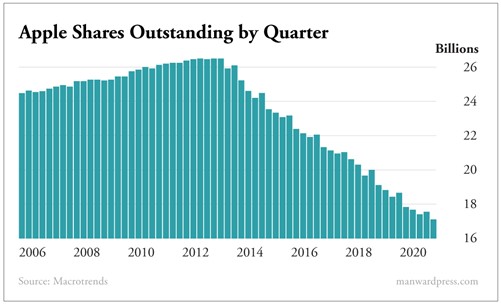
To overcome this, we pore through charts that show the number of shares outstanding. If the number is getting smaller, we know the company is making good on its promise.

Here’s the Apple chart we shared last week. It tells the tale…
Apple Shares
Good Thoughts

Before our little bluebird flies away, we’ll wrap up with one more note… this one from our self-proclaimed nemesis who appears to finally see things the way we do.

My Friend Andy,

You are so right. Money cannot buy you happiness and does not (but does buy freedom). I believe happiness comes from within and is inexorably dependent on optimism. I see my glass always as half full and so I am happy with that. I even love seeing I have some left to enjoy when the scotch tumbler is a quarter full.

Optimism is the key to happiness – is indeed the very source and essence of happiness in most cases – but even I admit it is hard to be optimistic when you are hungry and cold, living on the street in the rain. So yes, money can help meet the bare necessities of life – food, shelter and clothing (some measure of freedom) – but after that, happiness comes from within, with the optimism you bring to the future before you. And more importantly, you have to choose to be optimistic – it is a choice and that is the key – you have to choose to be optimistic, to see the good in people and to believe the best is yet to come. Regards, Your friendly nemesis (but just friendly today). – Reader J.H.

They’re the best words J.H. has ever written us. We’re optimistic that there’s hope for him after all.

We hope you have a bluebird day.

Buy crypto… own buybacks… and think positive thoughts.

And send your questions and comments to mailbag@manwardpress.com.

Don’t Let This Dead Investing Theory Cost You Money

An old friend is dead.

The obituary tells the tale. From humble beginnings in 1952… to massive stardom on Wall Street in the ’70s, ’80s and ’90s… to a quiet, lonesome death on January 27.

This death has important implications for your money and how you invest it.

We must admit, we were glad to see the news.

The time had come.

We’ve introduced you to the victim – modern portfolio theory – several times.

He was a grand ol’ fella with good intentions and an idea worth following.

The deceased Nobel Prize-winning theory, if you’re unfamiliar, told us to adjust our asset holdings based on their correlations to one another and their effect on overall portfolio risk.

Seventy years ago, when the idea was born, the math added up.

It made sense.

There was no quantitative easing… no bank bailouts… no mailbox money free-for-alls… and no darned millennials on the internet gumming things up.

The theory gave the Wall Street crowd something to rally on. It gave brokers and advisors some “science” to share with their clients.

We even used it ourself.

Wall Street vs. the Garden of Eden

As long as folks were convinced that up is always up and down is always down… the theory would hold. As long as an “efficient” market always righted the upside-down… modern portfolio theory was as scientifically solid as Newton’s musings on gravity.

But then along came the internet… that lousy rabble-rouser.

We’ve researched and written about the effects of the web on investing for quite a while. Its speed should make for ultra-efficient markets. Its reach should rope in information from all around the globe.

It does… sometimes.

But with the good comes the bad (Isn’t that right, Mrs. Manward?). It’s the internet’s original sin… the forbidden apple of lousy ideas and even worse information.

Few mortals have the faith it takes to avoid taking a bite.

And so on January 27, we all paid the price. That’s the day a band of hooligans got together in an online forum and organized a plot to put a knife to the throat of the feeble, old theory.

As they bid up the shares of nearly defunct brick-and-mortar video retailer GameStop (GME), they slid the knife across the jugular. With each dollar the stock moved higher, the knife slid further and further across the throat.

As the mob moved from one stock to the next, the famed modern portfolio theory was dead and lying on the trading room floor. The heart of the idea – efficient markets – had bled out.

The Silver Dagger

But it’s not just this headline-grabbing mob.

Oh no… it’s Elon Musk. A single tweet will send the oddball crypto Dogecoin soaring.

And it’s not just the high-flying crypto market either. Far from it.

The idea behind the late modern portfolio theory tells us that precious metals buoy our portfolios in turbulent times like these.

Ha.

The silver market got slapped around by the mob too.

The $1.5 trillion market saw its price surge by more than 15% as reporter after reporter found joy in amplifying the half-baked squeeze.

The reporting and the ignorance behind it all got so bad that we wouldn’t be surprised if there were lines outside the local fried seafood shack after the headline-chasing crowd heard “Long Silver.”

Surely the news has been a boon for Long John Silver’s.

It’s all pretty silly… and, in many cases, downright stupid.

But it does have serious consequences.

Investing Must Change

Folks still managing their money the old way don’t realize the theory behind their logic has died. The mob sharpened its knife while Elon Musk dug the grave.

Does it mean that the markets are unsafe… that the naysayers were right all along – the whole thing is a rigged casino?

Far from it.

We’ve been buying more shares than ever… and the market is kindly rewarding anybody who does.

What it means is we must invest differently.

The idea that bonds rise in value when stocks sink is no longer true. Not with Jay Powell waving his checkbook around.

The idea that growth pays when value doesn’t is now as quaint a theme as the rotary phone. The roving mob has made sure of it.

And the idea that up is up and down is down… has been killed by Twitter and the mouth breathers behind it.

In the generations since modern portfolio theory was born, many new asset classes have come to life.

Options, for example, were not available to the masses until the 1970s.

Exchange-traded funds have been popular for only the last 20 years or so.

And crypto? The forces, ideas and technology behind it were unthinkable during even the Clinton administration, let alone during the Truman era.

Their effect on the market begs us to invest differently.

It’s why we penned our Modern Asset Portfolio theory and made it the core of our Manward Letter. It takes the sound logic of yesteryear and tosses it into the blender with today’s modern assets and government heavy-handedness.

The result is a nimble and highly effective investment strategy that allows us to take advantage of the day’s most powerful forces. With it, we don’t have to bet on where the mob will head next… or what Musk will tweet tomorrow.

No… by tracking interest rates – the hormones of the economy – we can adjust our strategy as the most powerful force in the money world rises and falls.

We’ve got just a handful of categories. All are based on real interest rates (specifically the 10-year Treasury minus the rate of inflation).

Right now (and likely for the next two years), we are in the “negative rate” category – with a real rate of -1.04.

That means free money rules the day.

Buyback stocks are hot. Tech stocks and their balance sheets filled with intangibles will continue to drive big profits. So will the assets that catch all that free money… the so-called mob assets, like crypto and SPACs.

The investing canon recognizes none of this.

That’s too bad. It is costing folks a lot of money.

We pray they don’t learn about the death of their old friend when it’s too late.

The family could use some help paying funeral expenses.

When I’m Going to Get Back Into Stocks

The Dow has fallen.

A reader asks: Is it time to get back into stocks?

I’m not an investment advisor. I don’t feel comfortable telling others what to do with their money. I prefer to say what I’m doing and why and then let my readers decide if it makes sense for them.

So, am I getting back into stocks? Not now. I’ll tell you why.

How I Judge a Stock

We just went through one of the longest and largest bull markets in my lifetime. From March 9, 2009 to March 11, 2020, the Dow and S&P 500 rose 351% and 400%, respectively. That was a fun ride – and I’m glad I was on it. But it became clearer and clearer as time passed that the bull I was riding was getting old.

The day the World Health Organization declared the coronavirus a pandemic, the market tumbled 6%. It has fallen since then, and is currently down about 25% from its high. (Erasing more than $8 trillion of the U.S. market capitalization.)

When deciding to buy a stock, there are two simple ways I judge its value. The first, which I’ve been doing forever, is the price-to-earnings ratio (P/E). That is determined by dividing the stock price by the earnings per share. (If the price of stock X is $50, and the earnings per share are $5, the P/E is 10.)

There are other ways to measure share value. A popular one is the price-to-sales ratio. It is determined by dividing a company’s market cap (the total value of outstanding shares) by its revenue. This is a good quick way to compare prices of companies within a given industry, but it doesn’t make sense to value stocks across the board.

Another metric is the price-to-book ratio. A business’s book value is determined by subtracting its liabilities from its assets. You take that book value and divide it by the number of outstanding shares, which gives you the book value per share. Then you divide the share price by the book value per share. I don’t use this method because it’s just too much work for my purposes.


What I like about the P/E is that it corresponds to the way I value private businesses. I wouldn’t be interested in buying a company based on sales. And I certainly wouldn’t value it that way. I’m interested in profits. Earnings are profits.

The other thing I like about the P/E is that, because it values the shares on profits, it can be used to fairly value large, established businesses in most industries – from manufacturing to agriculture to communications to energy, and so on.

In other words, it’s useful for valuing the sort of stocks I want to own: large cap, dividend-giving, industry-dominating companies that have a long history of profitability and are likely to be here far into the future.

I Don’t Try to Beat the Market

If I traded stocks or invested in growth stocks, I’m sure I’d be interested in getting more sophisticated with my value calculations. But my strategy for stocks is based on my confidence that I do not and will not ever have the interest in or patience for beating long-term market averages. I’m happy to get 8% to 12% on my money over the long haul.

Today, the average P/E for the Dow is 16.4. That’s down two points from a year ago, and it’s getting very close to the historical average of 16. P/E ratios are not reliable predictors of short-term market moves, but over 10 years or more, they work pretty well. Thus, buying stocks with P/E ratios of 15 or less would make sense. And many value investors use that as a buy-in signal.

As an investor in private businesses, I have never paid anywhere near 15 times earnings. For newer, growing businesses, I’ve paid up to 10 times earnings. But for larger, established businesses in my industry, the range is usually a four to six times multiple of the average earnings over the prior three years.

In other words, for a business that made profits of $80,000, $100,000, and $120,000 over the prior three years (an average of $100,000 per year), I’d be willing to pay up to $600,000.

You can’t do that with larger, stable public companies. Priced at the historic P/E of 16, I’d have to pay $1.5 million for the same company.

The reason for this is supply and demand. In the public sector, there are billions of dollars of buying demand every day. The larger, institutional buyers are happy to pay 16 times earnings for the sorts of stocks I prefer to buy. And they usually will. So for me, I’m motivated to buy these stocks in the 12 to 14 P/E range.

The Dow-to-Gold Ratio

Recently, I’ve added a second tool to my valuation kit. I’m not exactly sure how I will use it, but I’m looking at it because I think it makes sense.

It’s called the Dow-to-Gold ratio. I learned about it from Bill Bonner, the founder of Agora, and Tom Dyson, a colleague, who helped me assemble the core holdings of the stock portfolio I have now.

Here’s how Tom described this tool:

It’s NOT a speculation in gold. It’s a long-term buy-and-hold stock market investment strategy… with a simple market-timing element that helps us buy low and sell high.

Most of the time, we hold the stock of the world’s best dividend-raising companies. We call these “dividend aristocrats” – companies like McDonald’s, Coca-Cola, Hershey’s, P&G, J&J, and Philip Morris. [Note: This is basically the same core group that I have in Legacy stocks. No surprise there, since Tom helped design the Legacy Portfolio.]

Some of the time – when these stocks get too overbought and expensive – we go to the sidelines in gold.

We never cash out. And we never hold anything except gold and dividend aristocrats. We just wait for the Dow-to-Gold ratio to reach extremes… and then we rotate between stocks and gold accordingly.

As such, the Dow-to-Gold ratio is the only number that matters to us.

For Bill and Tom, the Dow-to-Gold buy-in ratio is 5. When they can buy all the Dow stocks for five times the value of an ounce of gold, they will be all-in.

Right now, the ratio is well above 5. But it’s moving down with stock prices down and gold moving up. It’s likely that gold will move up considerably more if the economy doesn’t drastically improve by midsummer. If that’s the case, we will see the Dow-to-Gold ratio moving toward 5.

But I’m not going to wait that long. As I said, this is a new metric for me. It makes the most sense in the long view. As individual stocks that I favor move toward a P/E of 12 and the Dow-to-Gold ratio continues to drop, I’ll start buying.

But on an individual basis.

In the meantime, I’ll keep my money in cash and wait to see what happens.

Like what you’re reading? Let us know here.

Part 2: What I’m Doing (and Not Doing) to Safeguard My Wealth

On Friday, I talked to you about the history of stock market crashes to show you that we have gone through hard times before, and the market has always been able to recover.

Today, I want to tell you what I’m doing to safeguard my wealth.

I’ve written about the stock market at least a dozen times over the past 10 years. And in each of those essays I’ve reminded readers that I don’t have a crystal ball, and that my guess about the market’s future is as valid as your next Uber driver’s.

In my lifetime as an investor, I’ve seen several serious bear markets. Had I been able to predict their tops and bottoms, I would have cashed out my stocks early, moved into cash and gold during the descent, and put back that and some more at the bottom.

But since I’ve never had a crystal ball, I’ve never tried to time the market. I’ve always taken the view that, while I can’t know how steeply the market may drop or how long the recession might last, sooner or later prices will return to their pre-crash peaks, and then continue to move up from there.

I should say, though, that this strategy makes sense only when the stocks you own are in large, profitable businesses that are antifragile, that have the resources a business needs to survive a crash and even an extended recession.

And, as long-time readers know, my Legacy Portfolio is populated exclusively with companies like that.

What Is the Legacy Portfolio?

It’s the easiest, safest, most consistently successful strategy for building wealth in the stock market.

The goal of the Legacy Portfolio is to accumulate shares of no more than 10-25 of the world’s best companies when they’re “on sale,” holding well into retirement. We adopt a long-term mentality, whereas most investors are reckless and trade in and out of stocks, chasing invisible returns. We plan to never sell. By doing this, we take advantage of the power of compounding, through price appreciation and growing dividends.

What About Buying Gold?

I bought a fair amount of gold back in 2004, when it was selling for $400 an ounce.

I didn’t buy it as a hedge against the dollar or the stock market. I bought bullion coins (mostly) as a “chaos” hedge. A stockpile of tradable hard assets that might come in handy if the world economy moved into another depression, like we had in the 1930s.

If we do see that economic era repeated, the value of my gold will almost surely continue to increase. But I’m not counting on that. Its purpose isn’t to compensate for the paper wealth I’d lose in stocks, but to be a form of insurance – “just in case” currency that I could use to buy necessities for family and friends.

Which raises the question: When and how do you buy gold? And the answer is, you buy it just like you buy any sort of insurance. Figure out the likelihood of the risk. Determine how much coverage you would need. And then decide if the premium you have to pay is worth it.

When I decided to buy gold coins, I bought enough of them (at an average price of $450) to sustain my family and my core business for a good length of time. I didn’t buy enough to cover historical expenses for many years. I bought enough to pay for the basics. And that helped me feel more secure.

But that was hardly all that I did to protect my family’s wealth against a stock market crash and a recession. It was just one piece of a financial structure I began setting up 40 years ago and began writing about when I started writing about wealth nearly 30 years ago.

What About Stockpiling Cash?

I like having a portion of my net investible assets in cash for all the obvious reasons – doing my own banking, using it for fast moving investment opportunities, and as part of my insurance program against crises like this one.

But that feeling is counterbalanced by the recognition that cash is generally a low- or no-return asset class and therefore having a lot of it means that I won’t be taking advantage of the historically high returns of the stock market, the real estate market, private equity, and private lending.

I don’t have a fixed number in my head about how much cash I should have at any one time. I let the markets make those decisions for me.

I don’t, for example, invest in rental real estate properties when I can’t find properties I can buy for less than eight times gross rent. Likewise I don’t buy any additional shares of Legacy Stocks when their P/E ratios are expensive by historical standards.

By adhering strictly to these sorts of value-based investing strategies I am effectively prevented from putting my new earnings into any one of them. And that means I end up accumulating lots of cash while these markets are expensive.

In the past half-dozen years, most stocks – including most of my Legacy Stocks – have been so expensive (relative to earnings) that I have not allowed myself to buy them. This means that the dividends I’ve been receiving for the stocks in my Legacy Portfolio have been going into my cash account. And that is okay with me.

I normally put a good chunk of my earnings every year into real estate. About 10 years ago I began selling off my individual units and moving into apartments, where I could get better yields with less hassle. But the number of such deals I could find has diminished to a trickle in the last three or four years. Again, by sticking to my valuation standards, I’ve been effectively locked out of these markets, too.

I have put some money into private debt and private equity. But only when I knew the borrowers and the businesses very well and felt sure my lending was secure.

In past essays on the stock market I’ve said that to make my wealth as antifragile as possible, I did my projections based on a stock market crash of 50%. When I first picked that number nearly 15 years ago, it seemed like quite a long shot. Today it doesn’t feel so crazy.

Now What?

As I’ve alluded to, my core investment philosophy mimics Nassim Taleb’s concept of “antifragility.”

In his bestselling book Antifragile, Taleb defined antifragility as the ability to not only survive, but also to benefit from random events, errors, and volatility.

My version of that is very simple…

I invest primarily for income, not for growth. That means rental real estate, bonds, private debt, income-producing equity and dividend yielding stocks. Depending on the economy, not less than 80% and sometimes as much as 90% of my net investible wealth is in income-producing assets.

I invest in what is proven today, not what might happen tomorrow. Investing in income-producing assets means investing in current facts, not future possibilities. This is, admittedly, a conservative approach to wealth building. I am willing to give up the potential for cashing in big on the upside for a smaller but virtually guaranteed return.

I don’t gamble. I am as tempted to invest in attractive speculations as the next person. But I’ve learned from experience that is a bad idea. My historical ROI for the speculation I’ve made is nearly perfect. I’ve lost almost all my money every single time. I will occasionally invest in a friend’s business. But when I do that I consider it a gift. I expect no return and usually get no return. So I limit those “investments” to how much I’m willing to lose.

I pay attention to value. I invest exclusively in income-producing assets, but that doesn’t mean I don’t pay attention to how much they are worth. As I said above, I invest in stocks when they are well-priced relative to their P/E ratios (among other metrics). I invest in real estate when I can buy properties that are inexpensive relative to their rental income. I buy debt when I can get a yield that is at least better than inflation, etc.

I hope for the best but plan for the worst. In terms of antifragility, nothing is more important than planning for the worst. Planning for the worst in good times allows you to survive and even thrive during the bad times. My worst-case planning began by imagining almost everything going wrong at one time. The market collapses. The economy moves into a deep recession. My businesses fail. The whole nine yards.

When you think that way, you have no choice but to include all the fundamental asset-protection strategies in your financial planning, as well as a few more.

Diversification. I won’t waste our time talking about the importance of diversifying financial assets. I don’t look at it as a theory. I see it as a fact. To achieve maximum antifragility, dividing one’s financial assets into different classes is rule number one.

Position sizing. In my humble opinion, position sizing (limiting how much money you put into any particular investment) is almost as important as diversification itself. When your investible net worth is relatively small you might have to limit individual investments to 10% of your portfolio. The goal, as you acquire wealth, is to reduce that percentage as you go along. These days I rarely put more than 1% of my net investible wealth in any investment.

Here’s a Look at My Portfolio

Stocks: I came into the stock investing game late. And cautiously. When I set up the Legacy Portfolio about 14 years ago, I invested what was at that time 10% of my net investible wealth in those stocks.

Thanks to the bull market that followed, my stock account doubled and stood, at the beginning of the corona crisis, at about 20% of the portfolio. That’s a good deal. But it’s still only 20%. So when the market is down 30% like it is today, that means my net investible wealth is down by 6%. If the market continues to fall to 50% – my worst-case scenario – then I’ll be down 10% overall. Not good, but not bad either.

My strategy for stocks is to hold on and wait for the market to recover. It might happen in six months (unlikely). It might happen in a year (possible). Or it might happen in 10 years (safe bet.) I’m hoping the return will be sooner rather than later, but I’ve planned for later so I’m not going to fret about it.

Debt: About 10% of my net investible worth is in debt instruments. My debt portfolio is diversified among bonds and private lending. Because of the private debt I’m getting decent returns – from 4% to 12% on most of my deals. For a while I’ve not been able to buy good debt at good prices. But that may change. If so, that’s where some of the cash will go.

Ongoing Enterprises: About 20% of my net investible wealth is invested in about a half-dozen private companies, ranging from $10 million to $1 billion. This is where I get the lion’s share of my current income. I’m very concerned that income may slow or dry up completely in the next year. If it does, I will have to turn to other income sources. In the meantime, I’m working hard to keep those businesses afloat.

Real Estate: About 40% of my net investible wealth is invested in real estate, and 80% of that is in income-producing properties in various locations. If all of these properties were leveraged, I’d be worried. But my debt on them is less than 5%. I may see diminished income, but in the worst-case scenario it will be a 25% drop, which would still be acceptable.

Hard Assets and Cash: About 5% of my net investible wealth is in hard assets like bullion coins, rare coins, and investment-grade art. These are last-refuge resources. For the time being I have not thought of tapping into them. That could change.

Cash: As I explained above, my cash position has grown in the past several years because my preferred income-producing assets have gotten pricey. I’m expecting that some time before this crisis is over, cash will be king again. I’m waiting for that.

So What Am I Doing?

I’m doing just about nothing right now. I’m not selling stocks. I’m not selling real estate. I’m not selling my businesses, my private equity. I’m not even selling my debt.

For the moment I don’t feel that I need to make any changes, because many years ago I put in these safeguards in order to protect my family’s wealth.

We are going to get poorer. That’s for sure. But I’m not making any changes because the way I diversified my assets 20 years ago seems to be giving me the protection I had hoped it would today.

What About You?

If you have been reading my writing these past 20 years and even loosely following my strategy, you should be in more or less the same position I am. If you feel good about that, as I do, then you will probably want to do exactly what I’m doing: mostly nothing.

But if you aren’t diversified, and have the lion’s share of your money in cryptos or growth stocks – well then, you are going to have to listen to the advice of the people that persuaded you to put so much of your money in those deals.

And while you are doing that, don’t despair. And double down on your day job. Things will get better eventually and if you are getting better (investing smarter) in the meantime, you’ll be fine after it all shakes out.

Editor’s Note: Mark’s “chaos hedge” – gold – is entering a new and powerful bull market. So if you want to both protect and, more importantly, GROW your wealth in the coming years, then you need to check out what we’re calling the PERFECT gold investment for 2020. Click here to discover the BEST possible way to grow your money… with legally guaranteed returns of up to 109%!

Like what you’re reading? Let us know your thoughts at mailbag@manwardpress.com.

BROUGHT TO YOU BY MANWARD PRESS